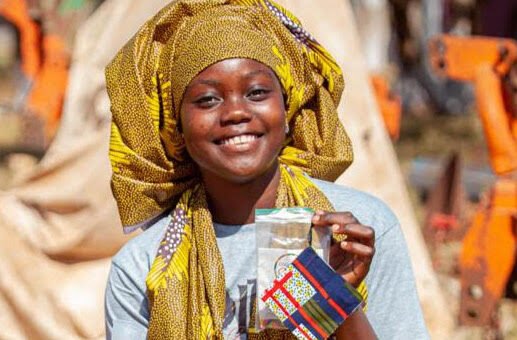
CouldYou?, a nonprofit dedicated to empowering women and girls through innovative health and education programs, is working to end period poverty with the CouldYou? Cup, a reusable, FDA-registered, 100% medical-grade silicone menstrual cup that lasts up to ten years. With more than 220,000 cups distributed across Africa, with a 2m waitlist, the program is proving that long-term, sustainable solutions can transform health, education, and dignity for women and girls, even in refugee camps, rural villages, and prisons.
Every month, 500 million women and girls worldwide struggle with period poverty, unable to access safe, affordable, and sustainable menstrual products. The consequences ripple across health, education, and economics: girls miss three to five days of school each month, women miss work, and families face ongoing financial strain. According to the World Bank, failure of girls to complete 12 years of education costs the global economy $15–30 trillion in lost earnings.
CouldYou? is committed to breaking this cycle. The organization’s flagship intervention, the CouldYou? Cup, is a medical-grade silicone menstrual cup designed to last up to ten years for a one-time cost of $10. Distributed through schools, NGOs, faith communities, refugee camps, health clinics, and local government partners, the cup has already reached over 220,000 women and girls with a 91–97% acceptability rate.
The menstrual cup is not only a cost-saving alternative but also a proven health intervention. Multiple randomized controlled trials (RCTs) confirm its safety and benefits:
Most strikingly, the Liverpool School of Tropical Medicine’s seven-year study revealed that girls who used cups experienced a 33% reduction in HSV-2 (a virus that triples the risk of HIV), a 24% reduction in bacterial vaginosis, and a 37% increase in protective vaginal bacteria.
In Ghana’s Wa East region, a Plan International–funded study found that 83% of adolescent girls engaged in transactional sex to afford pads. CouldYou?’s pilot served 2,000 girls in Wa East, achieving 97% acceptability. Results were published in the British Journal of Healthcare and Medical Research, and CouldYou? has since been invited to author a chapter in The Elgar Companion to Social Innovation and the UN Sustainable Development Goals. (forthcoming Q1 2026)
In Kenya, Koitaleel Somoei University College (KSUC), a Constituent College of the University of Nairobi, recognized that many students were missing classes due to lack of menstrual products. In response, they partnered with CouldYou? to launch a revolving fund: girls will be able to access a cup and health education and have one academic year to repay the $10 cost. Any unpaid balance is added to their tuition bill, guaranteeing repayment and ensuring long-term sustainability.
Despite mounting evidence, myths persist, that cups are unsafe, culturally unacceptable, or impossible to use in low-water settings. CouldYou? counters these misconceptions by combining distribution with comprehensive health education:
As one African Ministry of Education reported, “The CouldYou? Cup program is helping retain girls in school” evidence that this intervention is as much about education and empowerment as it is about health.
Today’s funding constraints make it more important than ever to invest in solutions that deliver long-term impact. Disposable pad programs require endless replenishment, straining budgets and contributing to environmental waste. In contrast, the CouldYou? Cup costs just $1 per girl per year, saves 89 kg of CO₂ emissions per cup, and frees families from the recurring expense of menstrual products.
As Christine Garde-Denning, Founder and CEO of CouldYou?, puts it: “Answering people’s questions, debunking myths, and normalizing the menstrual cup is more relevant than ever. In a world of limited resources, sustainable solutions like the menstrual cup aren’t optional, they’re essential.”
CouldYou? is a nonprofit organization dedicated to empowering women and girls through innovative health, education, and economic development initiatives. Its flagship program, the CouldYou? Cup, combines sustainable menstrual products with health education to tackle period poverty worldwide.