

Across Europe, cancer care stands at a critical inflection point. Incidence is rising, inequalities are deepening, and the distance between what science knows and what health systems deliver remains dangerously wide. Amid these challenges, one of the most unexpected and compelling transformation stories is now emerging from Bulgaria, a country proving that meaningful system change is possible when evidence, governance, and innovation are aligned.
Over the past year, Bulgaria has embarked on an ambitious redesign of its oncology landscape. Through its participation in the CCI4EU initiative, the country is building a new model of Comprehensive Cancer Infrastructure that integrates care, research, education, prevention, and quality assurance into one coherent ecosystem. This process has been driven by the Bulgarian Joint Cancer Network (BJCN), in close collaboration with leading national hospitals and international scientific bodies such as the Organisation of European Cancer Institutes (OECI) and the International Agency for Research on Cancer (IARC). What is emerging is not an abstract concept, but a tangible framework capable of reducing delays, strengthening multidisciplinary coordination, and supporting more equitable outcomes for patients across the country.
One of the defining achievements of this reform is the development of Bulgaria’s multidisciplinary clinical guideline, created using the internationally recognised GRADE methodology. For the first time, clinicians in the country have access to a transparent, evidence-ranked decision-making tool that aligns with global standards and links clinical recommendations directly to measurable quality indicators. This guideline is far more than a technical document – it signals the shift toward a culture of accountability and scientific clarity in a domain where inconsistency has long been the norm.
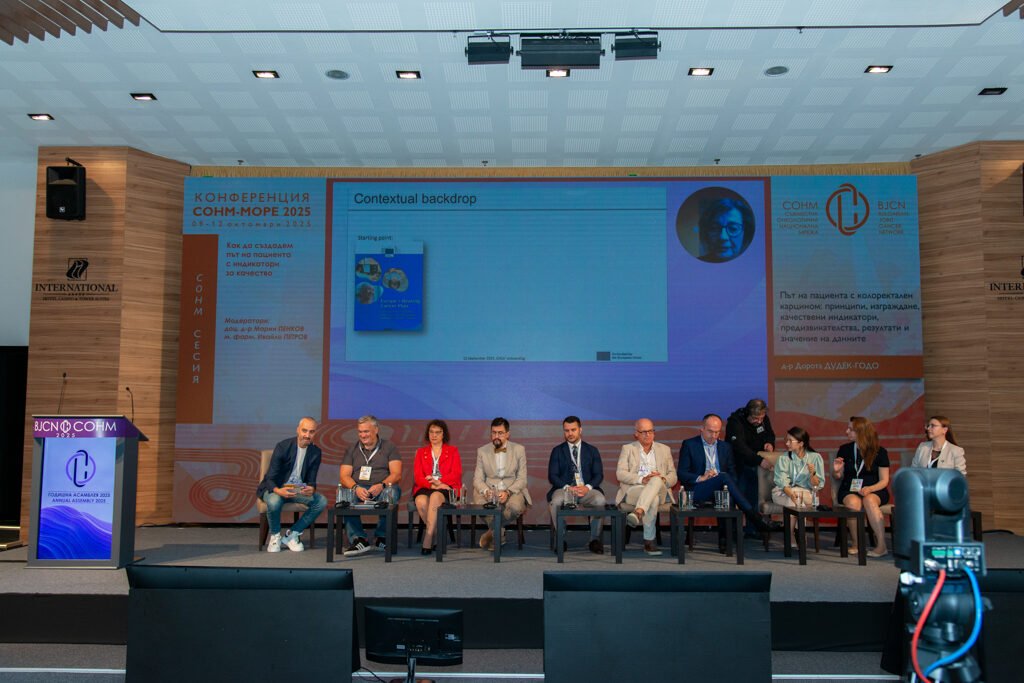
In parallel, national experts, supported by IARC, have established Bulgaria’s first structured participant pathway for HPV-based screening. This model brings long-needed coherence to early detection by outlining a clear, traceable journey from invitation and triage to diagnosis, treatment, and follow-up care. With newly defined screening indicators, early detection becomes not just a medical activity but a measured national process, designed to reach women regardless of where they live. As IARC researcher Dr. Nadya Dimitrova noted during this year’s BJCN–MORE 2025 Assembly, Bulgaria is finally laying the foundations for systematic population-based screening after years of fragmentation and variability.
The same spirit of integration is reflected in Bulgaria’s first pilot Comprehensive Cancer Infrastructure, which was presented publicly in 2025. Focused on cervical and colorectal cancers, the pilot maps the complete patient journey and embeds quality indicators that reflect timeliness, consistency, multidisciplinary collaboration, and continuity of care. The pilot demonstrates that comprehensive cancer care is not an emblem reserved for highly resourced health systems; it is a practical, achievable framework when clinical teams work together within a structured, transparent model. As emphasised by French oncology surgeon Prof. Serge Evrard, whose lecture on the fundamentals of comprehensive cancer centres resonated strongly at the Assembly, multidisciplinary coordination is not optional. Surgery, radiotherapy, and medical oncology must function as an integrated unit if a country is to deliver credible, modern cancer care.
Perhaps the most future-oriented component of Bulgaria’s transformation is unfolding in the field of digital oncology. For the first time globally, Bulgaria presented a generative artificial intelligence (Gen-AI) model built on a modified GRADE evidence framework. This AI assistant, developed by BJCN partners, is capable of synthesising clinical evidence through GRADE/PICO logic and generating rapid, transparent, and contextually justified recommendations for multidisciplinary tumour boards/teams (MDTs). Instead of replacing expertise, the system strengthens it, providing clinicians with a structured, explainable support tool that addressing biases and accelerates evidence-based decision-making and reduces unwarranted variation. Prof. Holger Schünemann, one of the founders of the GRADE approach, described this convergence of AI and evidence-based medicine as the natural next frontier, one that promises to amplify quality while safeguarding clinical judgment.
Taken together, these developments illustrate a broader truth about the country’s trajectory. Bulgaria is not merely implementing isolated interventions, it is constructing a new paradigm for cancer care. One that bridges prevention with treatment, integrates data with practice, and connects national expertise with European solidarity. The emerging model is coherent, measurable, person-centred, and anchored in science. It demonstrates that even in environments marked by resource constraints, structural fragmentation, or workforce pressure, transformation is possible when evidence drives decision-making and when multidisciplinary actors work toward a common purpose.
Bulgaria’s and based on the scientific and non-governmental first engagement, progress is ultimately a reminder that health-system change begins with clarity of vision and consistency of effort. When science and compassion converge, transformation becomes not only conceivable but observable. The country’s first Comprehensive Cancer Infrastructure is no longer a plan, it is already taking shape, offering a tangible demonstration of what equitable, high-quality, and data-driven oncology could look like.