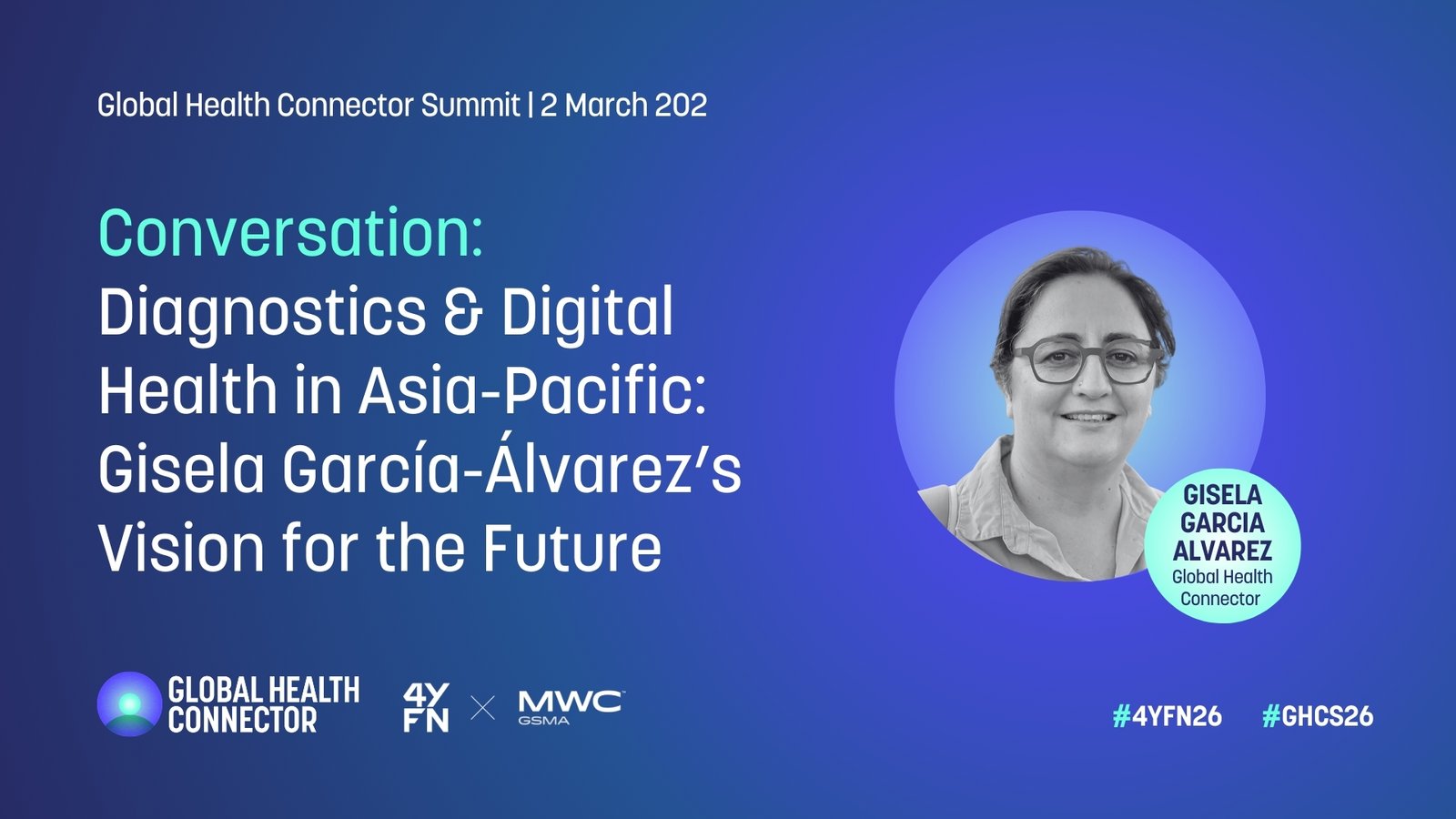
As our Global Health Connector Summit is approaching, we are exploring a key topic shaping the future of healthcare in the Asia-Pacific region: the role of diagnostics & digital health.
The Asia-Pacific (APAC) region is rapidly transforming healthcare, digital health, and life sciences. Diagnostics sit at the heart of this shift, driven by diverse population needs, rising disease burdens and gaps in access to care.
Global Health Connector continues its mission of bridging international health and innovation ecosystems by strengthening its presence in APAC. End of January, we launched Global Health Connector APAC in Singapore and appointed Gisela García-Álvarez as Executive Director, responsible for implementing and advancing the regional strategy.
Gisela will attend our summit in Barcelona, Spain, from 2-4 March 2026 to explore this topic in more depth. Here is a brief introduction to the subject ahead of her session.
Q1: What makes the APAC region uniquely positioned when it comes to digital health innovation? What do you see as the biggest challenges and opportunities?
APAC is uniquely positioned because it combines scale + diversity + urgency:
- Scale and unmet need: From dense megacities to remote islands, APAC has some of the world’s most diverse care settings—so solutions that work here tend to be resilient, scalable, and cost-sensitive. Digital health can genuinely “bridge care gaps” when designed for this reality.
- Fast-growing, innovation-ready ecosystems: Many APAC systems have rapidly modernised digital infrastructure, and Singapore in particular acts as a trusted regional gateway for building, validating and exporting health innovation.
- Strong translational platforms in Singapore: We have assets that help move from research to real-world adoption—e.g., HealthTEC.SG (ecosystem convening and translation) and A*STAR’s DxD Hub (productisation and clinical validation for diagnostics).
Big opportunities
- Decentralised care models (home/community/primary care) powered by digital workflows and point-of-care diagnostics.
- Cross-border innovation: APAC is perfect for “test, learn, scale” across multiple markets—if we do governance and partnerships right.
Big challenges
- Fragmented regulation and procurement across markets (and variable maturity of health systems).
- Data governance, privacy and interoperability—the region is moving forward, but frameworks still vary significantly and cross-border data flow remains hard.
- Implementation gap: moving from pilots to scaled adoption (clinical workflow fit, reimbursement, trust, change management).
Q2: How do you see diagnostics shaping the Asia-Pacific vision for the future of digital health, and why is the role of diagnostics so crucial to this transformation?
Diagnostics are the activation point of modern digital health: they convert symptoms and risk into actionable decisions – who needs care, where, how urgently, and what intervention works.
In APAC, that role is even more crucial because diagnostics help health systems:
- Shift left (prevention and early detection), which is essential when chronic disease burdens rise and specialist capacity is limited.
- Decentralise safely: point-of-care and near-patient testing make it possible to deliver quality decisions outside tertiary hospitals—critical for rural, remote, and fast-growing urban populations.
- Make AI meaningful: AI without high-quality clinical/biological signals is just prediction. Diagnostics (lab, imaging, genomics, sensors) provide the ground truth to stratify risk, monitor response, and personalise pathways.
Singapore is investing in exactly this “diagnostics-to-adoption” pipeline – A*STAR’s DxD Hub is explicitly designed to translate innovations into clinically validated diagnostic devices ready for market adoption.
Q3: Where do you see the biggest gaps in access to diagnostics across the region today, and how can digital solutions help to close them?
The biggest gaps I see across APAC are less about “whether a test exists” and more about whether people can access it at the right time, with a result that clinicians can trust and act on:
- Geographic access & logistics: Remote communities face delays in sample transport, shortages of lab capacity, and inconsistent service quality. Digital can help by orchestrating hub-and-spoke networks, sample tracking, and referral pathways—and by enabling validated point-of-care testing closer to the patient.
- Affordability and sustainable reimbursement: Even when tests are available, payment models and procurement can lag behind value. Diagnostics often remain undervalued relative to the system savings they unlock.
- Data fragmentation: Results are frequently siloed across providers and platforms. Without interoperability, we lose longitudinal insight and population-level intelligence. ASEAN-level work recognises the need for standards and governance to enable safer data sharing.
What digital can do (practically)
- Smart triage + routing (who gets tested, where, and what happens next)
- Remote ordering and results delivery integrated into care pathways (not just standalone apps)
- Quality and traceability: audit trails, QA, device connectivity, and decision support
- Population health dashboards for outbreaks and chronic disease management, aligned with regional digital health priorities.
Q4: What are your priorities in your new role as Executive Director of the Global Health Connector APAC, and what impact do you hope to achieve in the short and long term?
As Executive Director, my priority is to position Global Health Connector APAC as a practical and trusted platform for international collaboration, focused on translating dialogue into concrete initiatives with real-world impact.
In the short term, this means strengthening Singapore as the regional anchor and reference hub, aligning key ecosystem actors across industry, healthcare providers, research translation platforms and government-linked initiatives. At the same time, we are expanding deliberately into other priority markets, including Australia and emerging Southeast Asian ecosystems such as Indonesia, Malaysia and the Philippines, recognising that each market requires a tailored and context-specific approach.
Rather than spreading efforts thin, the focus for 2026 is to deliver two to three concrete APAC initiatives—such as cross-border validation pathways or targeted collaboration actions—that visibly connect the region to the wider Global Health Connector network.
Over the longer term, my ambition is for Global Health Connector APAC to be recognised as a reference connector between APAC and the other two Global Health Connector hubs, helping make cross-border collaboration and scaling more predictable through stronger trust, shared frameworks and clearer pathways to adoption.
The impact I want
- More solutions reaching patients faster, with measurable outcomes—not more pilots.
- Stronger clinical–industry collaboration and smoother translation from research to adoption, leveraging Singapore’s unique convening strength and productisation capability.
References
- HealthTEC.SG. National health innovation ecosystem platform supporting industry–public collaboration and practical adoption pathways in Singapore.
- World Health Organization. Global Strategy on Digital Health 2020–2025, setting the global policy framework for digital health adoption across WHO regions, including Asia-Pacific.
- APACMed. Strengthening Healthcare Systems Through the Critical Role of Diagnostics, industry perspective on diagnostics as foundational health system infrastructure in APAC.
- Duke-NUS Medical School. Research and policy analysis on enabling digital health adoption and implementation across Asia-Pacific health systems.
- ASEAN Secretariat. Regional initiatives and policy work on digital health adoption, interoperability and governance across ASEAN member states.