
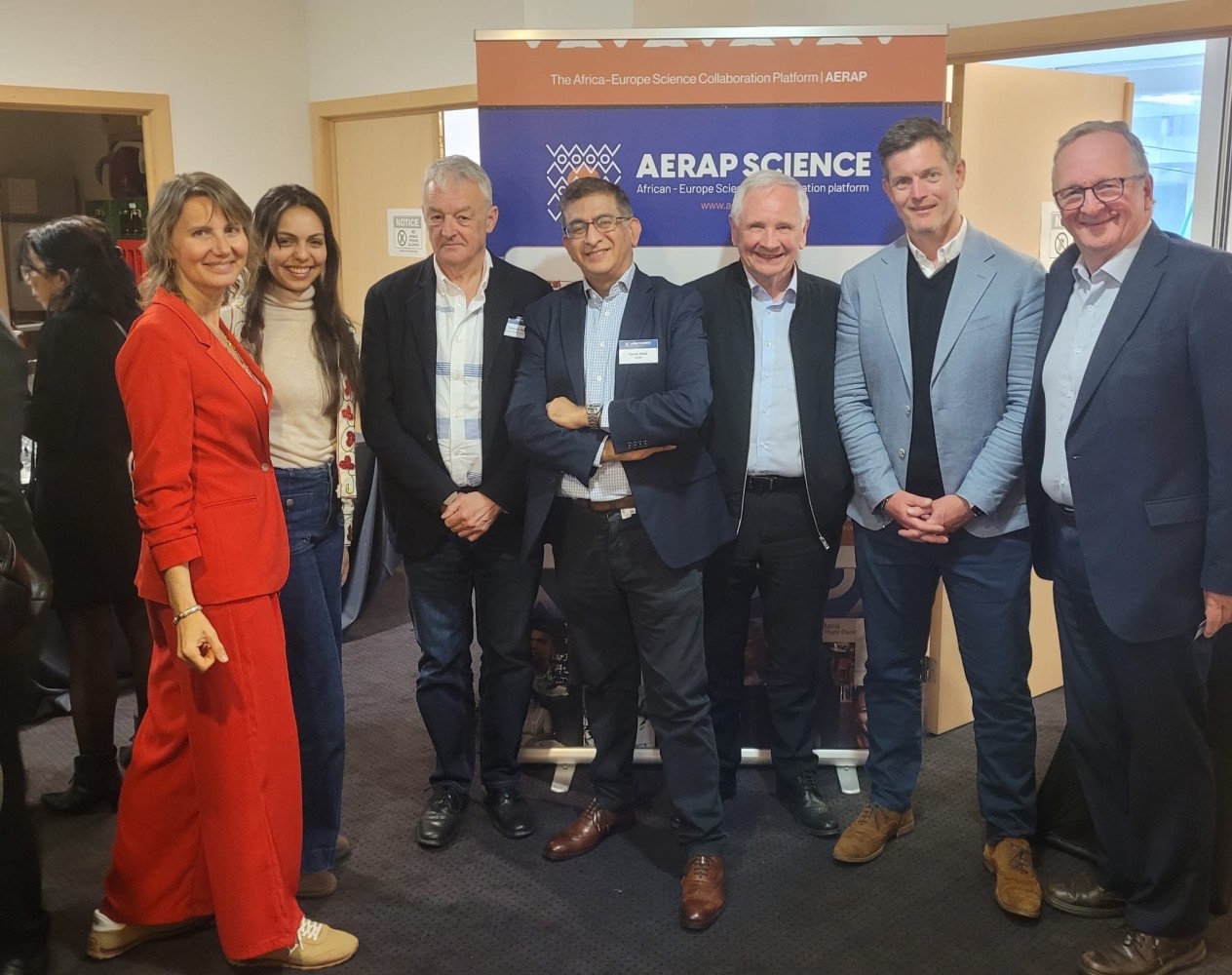
At the 13th Annual AERAP Forum, Global Health Connector co-organised a high-level session calling for a shift from dialogue to CollaborAction in Africa–Europe health partnerships. Bringing together leaders across policy, science, and industry, both in Brussels and live from Nairobi at the Africa Health Business Symposium 2026, the discussion highlighted the need for more equitable, visible, and results-driven collaboration to strengthen health systems across both continents.
At the 13th Annual AERAP Forum in Brussels, Belgium, Global Health Connector, in partnership with Africa–Europe Science Collaboration Platform (AERAP), convened a dedicated session on “Health for the Global Gateway: Strengthening Africa–Europe Health Systems through Science, Policy, and Investment”. Positioned within the broader context of evolving EU-Africa relations and upcoming frameworks such as the EU’s next Multiannual Financial Framework, the roundtable brought together policymakers, researchers, private sector leaders, and innovation actors to explore how collaboration can move beyond discussion to tangible outcomes.
Opening the session, Brian O’Connor, Chair of Global Health Connector, set the tone with a clear call to action: global health discussions must deliver outcomes, not just conversations. Emphasising the organisation’s mission to move from collaboration to CollaborAction, he underscored the importance of connecting stakeholders across continents and ensuring that innovation translates into real-world impact.
A defining feature of the session was its hybrid format, linking participants in Brussels with partners attending the Africa Health Business Symposium 2026 in Nairobi, Kenya. This dual-continent engagement reinforced a central message repeated throughout the discussion: Africa–Europe collaboration must be practical, visible, and mutually beneficial.
Rizwana Mia (South African Medical Research Council) opened the discussion by challenging traditional narratives, stressing that Africa is “not a charity case” but a continent rich in scientific potential and innovation capacity. She highlighted the importance of integrating Africa into the global shift toward precision medicine and data-driven healthcare, warning that failure to do so risks reinforcing a two-tier global health system. Investments in genomics, data infrastructure, and digital health ecosystems, she argued, are essential to ensure equitable participation in future health innovation.
From Nairobi, Marloes Kibacha (Africa Health Business) and Karolina Mackiewicz (Global Health Connector) emphasised the need to reshape perceptions. Both pointed to a disconnect between Europe’s intentions and its visibility on the ground in Africa, calling for clearer engagement strategies and stronger awareness of the continent’s rapidly evolving innovation landscape. They highlighted Africa’s growing middle class, entrepreneurial energy, and digital advancement as key opportunities for partnership.
The importance of translating science into scalable impact was further explored by Dr. Francis Ohanyido (West Africa Institute of Public Health), who outlined three priorities: co-design, convergence, and capability. He stressed that sustainable impact depends on contextualised solutions, stronger regulatory harmonisation, and long-term capacity building, rather than short-term, fragmented interventions.
Echoing this, Ota Akhigbe (eHealth Africa) reinforced that meaningful partnerships must be judged by their ability to strengthen systems over time. Innovation, she noted, only becomes transformative when it is embedded within functional infrastructure, supported by governance, and owned by local institutions.
A strong theme throughout the session was the need to better align investment with African priorities. Mosoka Fallah (Africa CDC) highlighted persistent fragmentation in research and funding across the continent, calling for improved mapping of capabilities, bottom-up priority setting, and stronger domestic investment in research and development. He stressed that demonstrating return on investment and linking science to tangible societal benefits will be critical to unlocking both public and private financing.
Private sector perspectives reinforced the urgency of this shift. Emmanuel Blin (Tech Care For All) pointed to a significant gap in Europe’s presence in African health markets, calling for stronger engagement and partnerships that support access to innovation. Meanwhile, Paresh Modi and Richard Cockle (GSMA) highlighted the transformative role of connectivity in healthcare, noting that digital infrastructure, mobile technologies, and data-sharing capabilities are essential enablers of equitable health systems. They also emphasised the reverse innovation potential, where solutions developed in Africa, such as mobile money or low-cost health technologies, can inform systems in Europe.
Dr. Mike Short (Global Health Connector) highlighted the growing importance of mobile data and sensing technologies in shaping future health systems. He emphasised that while connectivity enables new opportunities, real impact will depend on secure data sharing, common standards, and interoperability, ensuring that innovation can be effectively scaled and applied across regions.
The discussion also addressed structural challenges, including trust, governance, and sustainability. Andrzej Dąbkowski (Africa-Europe Foundation) and Silvi Serreqi (EISMEA) pointed to a gradual shift from traditional development cooperation toward co-investment and co-creation models, while stressing the need for transparency, shared ownership, and long-term implementation beyond short-term projects.
Equity remained a central concern, with Professor Nelson Sewankambo (Makerere University Medical School) warning of the risk of widening disparities if emerging technologies such as AI are not deployed inclusively. He called for stronger alignment between health research, policy, and economic development to ensure sustainable impact.
Innovation in practice was illustrated through examples such as Hannatu Ayuba’s work (Cancer Consciousness Initiative / TeleOncology Hub), who leads our Nigerian ecosystem, demonstrating how frugal innovation, digital tools, and community-based approaches can expand access to care. Her intervention underscored the importance of shared science, locally driven solutions, and financing models.
Adriana Díaz and Bleddyn Rees (Global Health Connector) highlighted the role of global health ecosystems in connecting stakeholders, scaling innovation, and avoiding duplication. Through our network of 90+ ecosystems worldwide, Global Health Connector aims to facilitate cross-border collaboration and accelerate the adoption of proven solutions.
The session concluded with reflections on a shifting mindset across Africa. Participants widely agreed that the continent is increasingly asserting itself not as a passive recipient of aid, but as an equal partner and co-investor in global health. This shift, combined with changing global funding dynamics, is creating new opportunities for more balanced and sustainable partnerships.
Closing the session, Brian O’Connor reiterated the need for long-term, outcome-driven CollaborAction. By aligning science, policy, and investment, and by building partnerships rooted in equity, trust, and shared value, Africa and Europe have a unique opportunity to co-create resilient, inclusive health systems that deliver lasting impact.