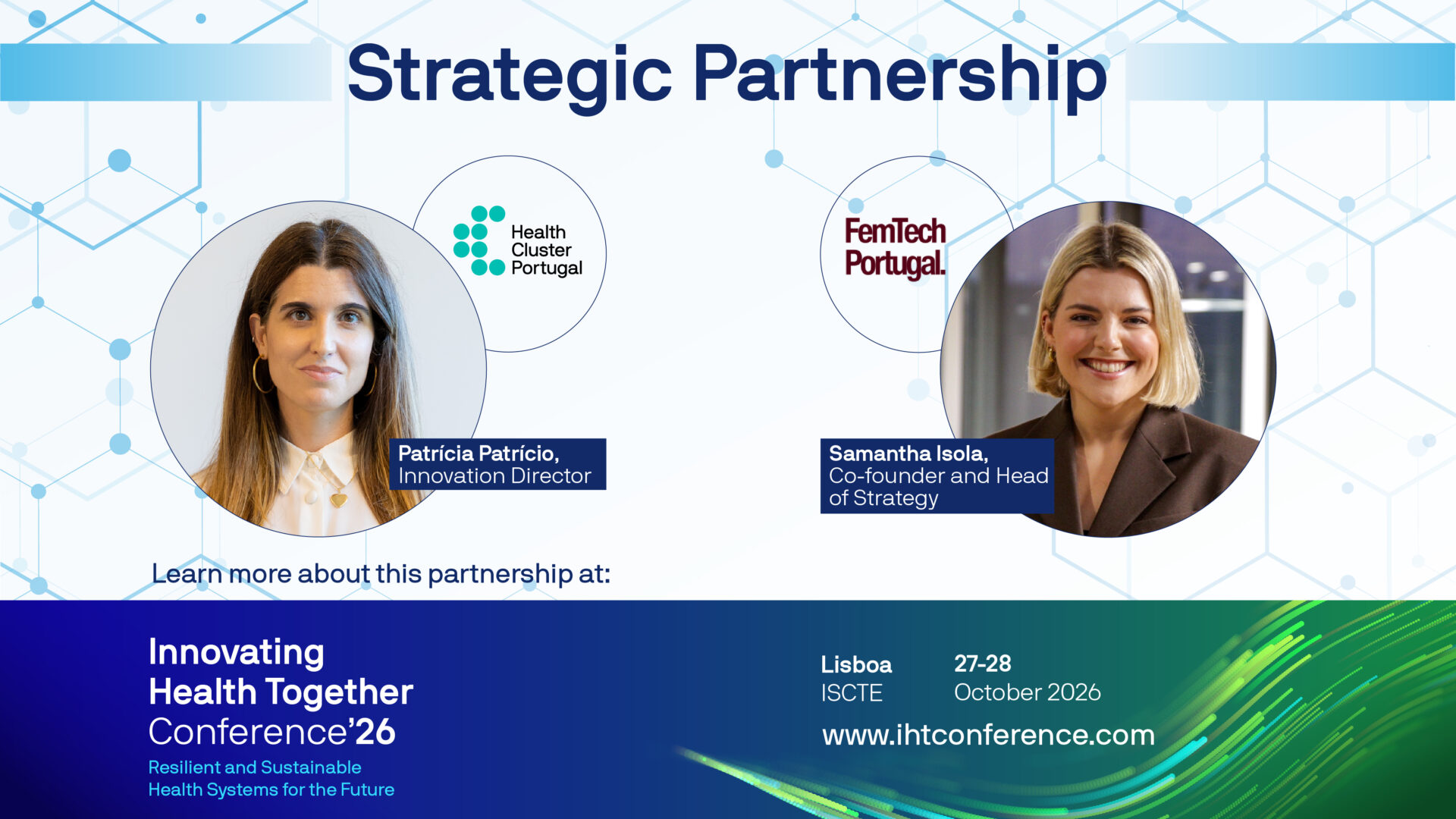
Patrícia Patricio (P): Samantha, to start, the term “FemTech” is moving out of the niche and gaining prominence. How do you define it today, and more importantly, why do you view it not just as a trend, but as a genuine “infrastructure for sustainable care”?
Samantha Isola (S): FemTech today is far broader than period trackers and fertility apps. It encompasses any technology, product, or innovation designed to address the health needs of women and people with female biology across the full lifespan, from reproductive health through to conditions that affect females disproportionately or differently to males that have historically been ignored or misdiagnosed entirely.
At FemTech Portugal, we see it as infrastructure because the gap it fills is structural and systemic. Women have been systematically underrepresented in clinical research, dismissed by healthcare professionals, and underserved by health systems built around a male default. FemTech is the correction to that. When you build tools that actually work for women, you improve outcomes, reduce diagnostic delays, and lower long-term costs for the entire healthcare system and society as a whole. It is not a trend, it is the foundation for what sustainable care looks like.
P: Our collaboration is just starting but I feel like it is central to this endeavour you just mentioned. On one hand, the Health Cluster Portugal offers the link to the broader health ecosystem, connecting hospitals, policymakers, innovators, while FemTech Portugal is building the ecosystem for women’s health innovation specifically, bringing together founders, healthcare professionals, investors and advocates to drive meaningful change. How do you see this on-the-ground collaboration, including the work we’re doing together for the Innovating Health Together Conference, which we’re organising, act as a practical accelerator for women’s health innovation?
S: Progress in women’s health does not happen in isolation. It requires the people building solutions to be in the same room as the people shaping policy, funding research, and running health systems. At the heart of that is access, ensuring women have access not only to better technologies and treatments, but to the knowledge, the advocacy and the system that make those things reachable in the first place. FemTech Portugal brings the community, the founders, the lived expertise and Health Cluster Portugal brings the institutional reach. What converts momentum into real change is organisations choosing to work together, to educate, to advocate, and to make the case that women’s health is not a niche priority but a systemic one. We are actively growing our network of partners who share this vision, because the more organisations that choose to collaborate rather than work in parallel, the faster we move.
Our work on the IHT Conference is a practical example of what becomes possible. It gives us a shared platform to put women’s health where it belongs, not as a side conversation but as a central pillar of how Portugal thinks about the future of healthcare. Visibility like that creates conditions for real collaboration, and real collaboration is what turns innovation into impact.
P: Moving onto the Portuguese ecosystem, what is the current scale and potential of FemTech innovation here? We know the potential is huge, and we already work with some of those innovators at the Cluster, but do you see any unique challenges for Portuguese founders in this space? Are they different from those of other healthtech innovation ecosystem segments?
S: Portugal punches above its weight in terms of founder ambition and clinical expertise, but the ecosystem is still at an early stage. We have brilliant people working on genuinely important problems, and a healthcare system that, at its best, is open to innovation. The potential is there, and more importantly, Portugal is an underutilised entry point into the EU market, small enough to build and pilot effectively, with the regulatory and cultural proximity to scale across Europe from here.
The challenges Portuguese founders face are not entirely unique but they are felt more acutely here. Access to early-stage capital remains limited, investor familiarity with women’s health is still low, and there is a cultural tendency to underestimate the market size, which affects both funding conversations and institutional buy-in.
At FemTech Portugal we are actively working to change that. We have mapped the first ever Portuguese Femtech Ecosystem Map to make the landscape visible to investors, partners, and founders themselves, and identified where the gaps are. We recently launched our Founders Circle membership to put that infrastructure to work, offering founders a community of peers, access to strategic support, and the visibility they need to grow.
P: To get to the crucial point, from my perspective, the urgent systemic barriers preventing better access to women’s healthcare are clear. They range from the lack of updated clinical guidelines that integrate new evidence, to the dispersion, or even lack, of data and a low incentive for the health system to adopt women-specific innovations. This fragmentation results in diagnostic delays and inequalities in access to specialised care. This brings us to the final question: What concrete changes do we need to implement for better patient access and systemic resilience?
S: You have highlighted the barriers clearly, and they are ones we recognise deeply. What needs to change operates on three levels.
First, data. We cannot close gaps we have not measured. Portugal needs a committed investment in women’s health research and the infrastructure to collect, share, and act on it. Second, policy. A national women’s health strategy is not a luxury, it is the foundation that gives innovators, clinicians, and investors a shared framework to build within. Third, community and education. Systems change when the people inside them understand why change is necessary. That means investing in awareness, in founder support, and in the kind of cross sector collaboration that brings everyone to the table.
With a partnership like Health Cluster Portugal and FemTech Portugal we can start connecting the people and making the case that accessible, inclusive women’s healthcare is not an overlooked priority. It is a prerequisite for a resilient health system, and Portugal has every opportunity to lead on it. Change of this kind rarely comes without resistance. Often that resistance comes not from bad intent but from a lack of education, or the deeply ingrained belief that because something has always been done one way, it must be the right way. Breaking that pattern is part of the work, and it is why advocacy, awareness, and partnership are just as important as innovation itself.
About the Health Cluster Portugal:
Health Cluster Portugal (HCP) is a private non-profit association that currently brings together over 240 members, including R&D institutions, universities, hospitals, civil society organizations, and companies in the pharmaceutical, biotechnology, medical technology, and services areas. More information can be found on the HCP website and on the LinkedIn page.

About FemTech Portugal:
FemTech Portugal is a non-profit association dedicated to accelerating women’s health innovation in Portugal. We bring together founders, healthcare professionals, researchers, investors, and advocates to connect, collaborate, and create a meaningful impact in women’s healthcare. Our mission is to build a strong and inclusive ecosystem that empowers innovation, supports collaboration, and amplifies the voices shaping the future of FemTech in Portugal and beyond.