
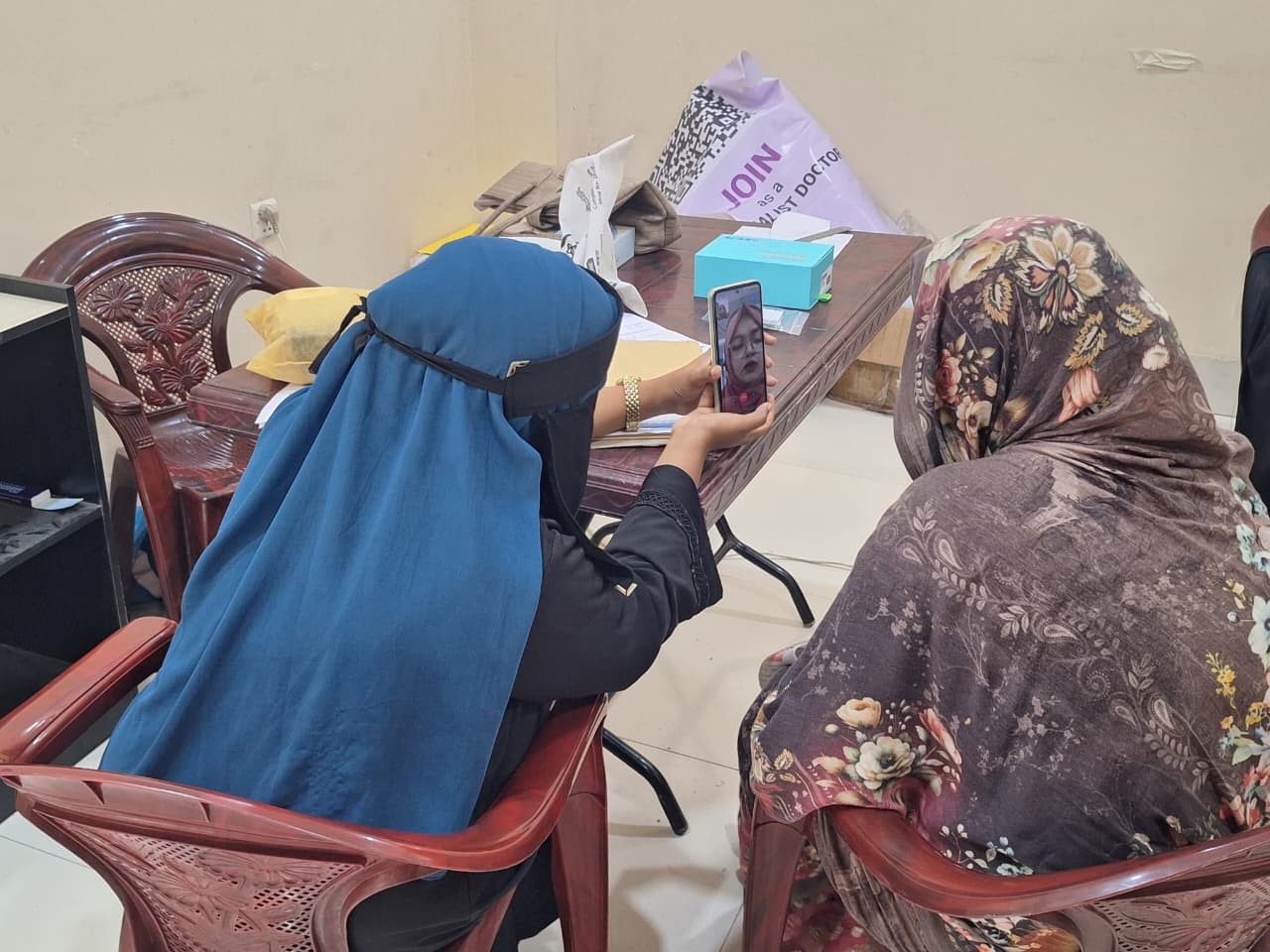
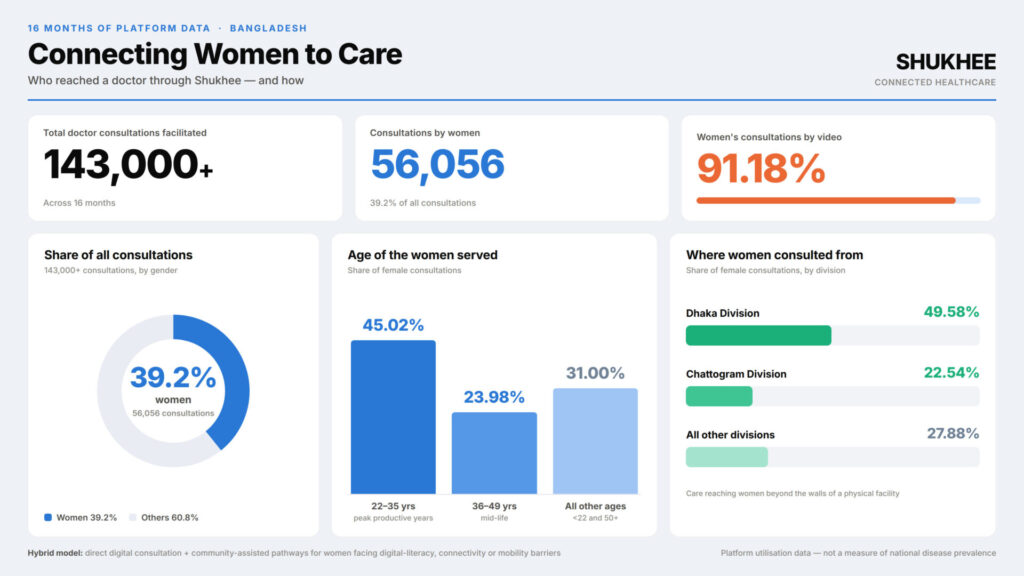
In just 16 months, Shukhee facilitated more than 143,000 doctor consultations, with women accounting for 39.2%—approximately 56,056 consultations. These numbers represent more than digital service utilization. They reflect growing opportunities for women to access professional healthcare despite barriers related to distance, time, mobility, privacy and conventional service availability.
Shukhee’s hybrid healthcare model combines digital consultations with community-assisted care, creating multiple pathways into the healthcare system. Women who can independently access digital services can connect directly with physicians, while community-based pathways can support those who experience digital-literacy, connectivity or technology-related barriers.
Among female consultations, video consultations represented 91.18%, highlighting strong utilization of visual, interactive clinical care. Women in their economically and socially productive years accounted for the largest share of consultations, with 45.02% aged 22–35 years and 23.98% aged 36–49 years.
Geographically, utilization was highest in Dhaka Division (49.58%), followed by Chattogram Division (22.54%), demonstrating the potential of connected healthcare to extend beyond physical healthcare facilities and serve women across diverse geographic settings.
Importantly, Shukhee’s data should be understood as platform utilization data, rather than a measure of national disease prevalence. Its value lies in demonstrating patterns of healthcare access and identifying opportunities to make digital healthcare more responsive to women’s needs.
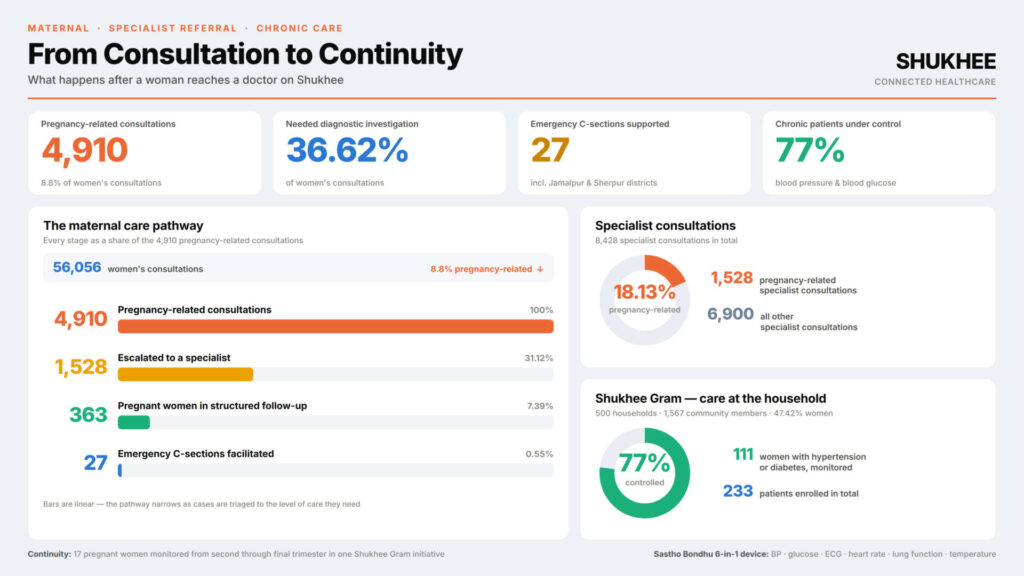
Women’s reproductive and maternal health represents an important component of Shukhee’s connected-care pathway. During the study period, 4,910 pregnancy-related consultations were documented, representing approximately 8.8% of female consultations.
Among 8,428 specialist consultations, 1,528 (18.13%) were pregnancy-related, indicating the importance of timely specialist referral within a digital primary-care pathway. Approximately 31.12% of documented pregnancy cases required specialist input, demonstrating the role of telehealth in identifying cases requiring higher-level clinical assessment.
Continuity of care was supported through follow-up for 363 pregnant women, while Shukhee facilitated clinical support for 27 emergency Caesarean-section cases, including patients from underserved districts such as Jamalpur and Sherpur.
The clinical data also demonstrate that women’s healthcare needs extend well beyond maternity care. 36.62% of female consultations required diagnostic investigations, while gynecological conditions represented a substantial proportion of women’s consultations. Infectious and general medical conditions also contributed significantly, with common presentations including viral fever, respiratory infections and scabies.
At the community level, the Shukhee Gram model further demonstrates how digital healthcare can be connected with physical follow-up. During one Shukhee Gram initiative, 17 pregnant women were monitored from the second trimester through the final trimester, enabling continued assessment, physician engagement and referral support throughout pregnancy, with the program aiming to support safe pregnancies and appropriate delivery outcomes.
Together, these experiences demonstrate how connected healthcare can create a pathway from early identification → clinical consultation → specialist referral → follow-up → continuity of care.
The impact of Shukhee extends beyond virtual consultations. Through Shukhee Gram, digital healthcare is connected with community-level follow-up, chronic disease monitoring, diagnostics, maternal health and referral support.
Across 500 households covering 1,567 community members, women represented 47.42% of the population. Among 233 enrolled patients, 111 women were living with chronic conditions including hypertension and diabetes. Through physician engagement, remote monitoring and community follow-up, 77% achieved controlled blood pressure and blood glucose levels, demonstrating the potential of hybrid care for ongoing chronic disease management.
The model also integrates community health workers and technology. The Sastho Bondhu 6-in-1 device enables community-level measurement of blood pressure, blood glucose, ECG, heart rate, lung function and body temperature, allowing health information to move from the household to healthcare professionals for assessment and follow-up.
Shukhee has also supported patients requiring more complex and continuous care, including telehealth support for chemotherapy patients through symptom monitoring and medication guidance.
These experiences point toward a broader model of healthcare: not simply telemedicine, but connected primary healthcare—where consultation, diagnostics, specialist referral, maternal care, chronic disease management, community follow-up and remote monitoring operate as parts of one ecosystem.
For Shukhee, the ambition is therefore not simply to put healthcare online. It is to create multiple, connected pathways to care, particularly for women who may otherwise face barriers to accessing timely and continuous healthcare.
The future of digital health is not digital-only care. It is connected, continuous and equitable care—where technology and human support work together to bring healthcare closer to where people live.