

Women’s health is receiving more attention than ever. Investment in FemTech is growing, conversations around reproductive and menopausal health are becoming more visible, and innovators are developing new tools to address long-standing gaps.
But visibility alone does not guarantee progress. Too often, promising solutions remain disconnected from clinical practice, health systems and the people they are intended to serve.
That is the question Global Health Connector will bring to HLTH USA this November (15-18): How do we move beyond the buzz and turn innovation in women’s health into accessible, equitable and integrated care?
Global Health Connector’s upcoming fishbowl session, “Beyond the Buzz: Why Women’s Health Still Falls Between Innovation & Care,” will explore why the gap between innovation and implementation persists, and what it will take to close it.
Led by Nicole Althaus, US Ambassador for Global Health Connector, the session will bring together clinical and innovation perspectives in an open, audience-driven discussion.
Session details:
The HLTH USA session builds on the conclusions of Global Health Connector’s previous fishbowl discussion on women’s health at HLTH Europe.
That conversation brought together leaders, clinicians and innovators to examine why advances in digital health so often fail to reach standard patient care. Its central message was clear: incremental change is not enough. Women’s health requires a structural shift across healthcare delivery, research, investment, data and education.
Seven priorities emerged from the discussion.
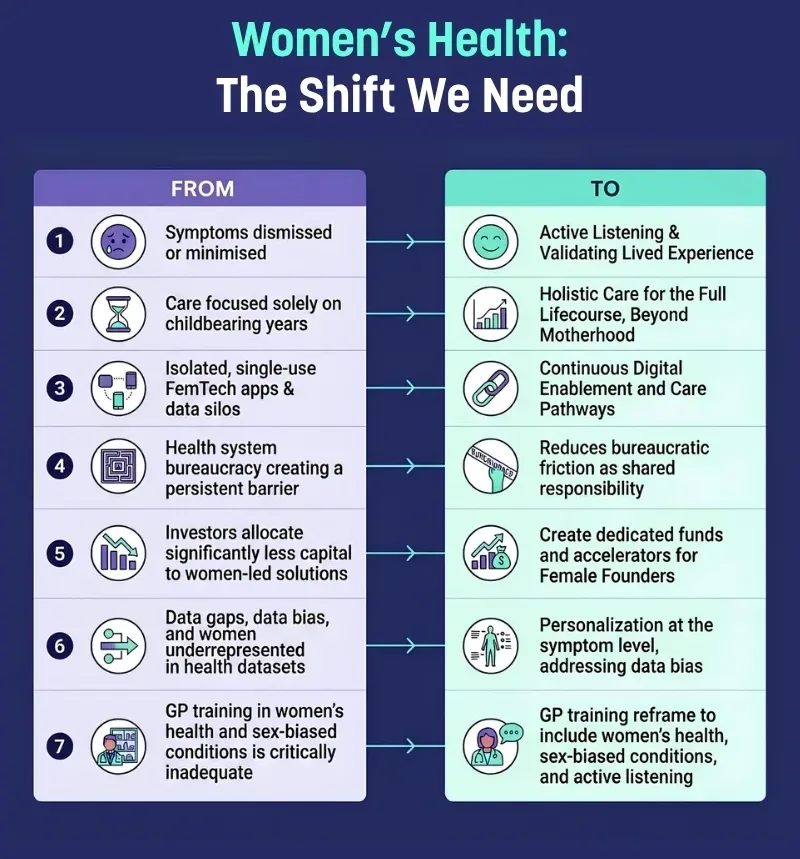
Women’s symptoms, including those associated with chronic pain, endometriosis, autoimmune conditions and perimenopause, have too often been minimised, misinterpreted or diagnosed too late.
Patient experience must be treated as a meaningful clinical signal. Active listening, validation and shared decision-making should become core elements of care.
Women’s health has historically been framed primarily around fertility, pregnancy and maternal care. These areas remain essential, but they represent only part of the picture.
A genuinely comprehensive approach must also address health before pregnancy, chronic conditions, cardiovascular and metabolic health, menopause, healthy ageing and the different needs that emerge throughout the lifecourse.
The growth of FemTech has produced a wide range of tracking tools and digital services. Yet many remain disconnected from primary care, specialist services and electronic health records.
Innovation will have greater impact when digital tools are integrated into existing care pathways, allowing data to support—not complicate—clinical decision-making.
Restrictive reimbursement models, complex health systems and regulatory uncertainty can prevent effective solutions from reaching patients.
Reducing this friction requires collaboration between innovators, providers, payers and regulators. No single stakeholder can redesign women’s health alone.
Women make up more than half of the global population, yet women’s health has historically received a disproportionately small share of investment.
Building a sustainable ecosystem requires dedicated funds, targeted accelerators and improved access to capital for founders developing solutions that address women’s health needs.
Historical gaps in medical research and clinical data have contributed to missed diagnoses, biased algorithms and care models that do not adequately reflect women’s experiences.
More inclusive clinical trials, sex-disaggregated data and personalised approaches are needed to ensure that research and technology serve diverse patient populations.
Many healthcare professionals receive limited training in sex-specific conditions and the ways symptoms can present differently across patients.
Women’s health should be embedded throughout medical education—not treated as a narrow specialty. Training should include active listening, conditions that disproportionately affect women and care across the full lifecourse.
Read the full Global Health Connector Women’s Health Session Report to explore the findings from HLTH Europe in more detail.
Women’s health cannot be transformed by innovation alone. It requires the combined effort of patients, clinicians, researchers, founders, investors, policymakers and health systems.
The women’s health fishbowl is just one element of Global Health Connector’s wider programme at HLTH USA, designed to connect international delegations, health system leaders, policymakers, investors, founders and ecosystem partners around shared priorities in innovation and equity.
On 15 November, the Global Health Connector Partner Programme will bring together global health delegations, health system executives and ecosystem builders to align priorities, foster cross-border partnerships and advance collaboration on health innovation.
Throughout the event, the Global Health Connector Village (Booth 829) will serve as a central hub, hosting delegations from Innovation Norway, Canada, Ireland and the City of Nashville, alongside live stage discussions, fireside chats, expert spotlights and dedicated spaces for one-to-one business matchmaking and networking between innovators, investors, buyers, clinicians and other stakeholders.
Large Regional Innovators Zones are SOLD OUT but we still have limited availability for our Small Regional Innovators Zones in the Global Village. Please contact estelle@globalhealthconnector.com.
The programme culminates on 17 November with the Startup Pitching Competition on the Village Stage, where ten selected health tech startups will present their solutions to an international panel, with finalists announced during the Partner Programme on 15 November.
Through our partnership with HLTH USA, we are pleased to offer a limited-time registration discount for our network:
Special Delegate Rate: $2,195
Discount Code: H26_GHC2195
Whether you are interested in exhibition or sponsorship/speaking opportunities, there is a way to get involved! For more information, please contact estelle@globalhealthconnector.com.