
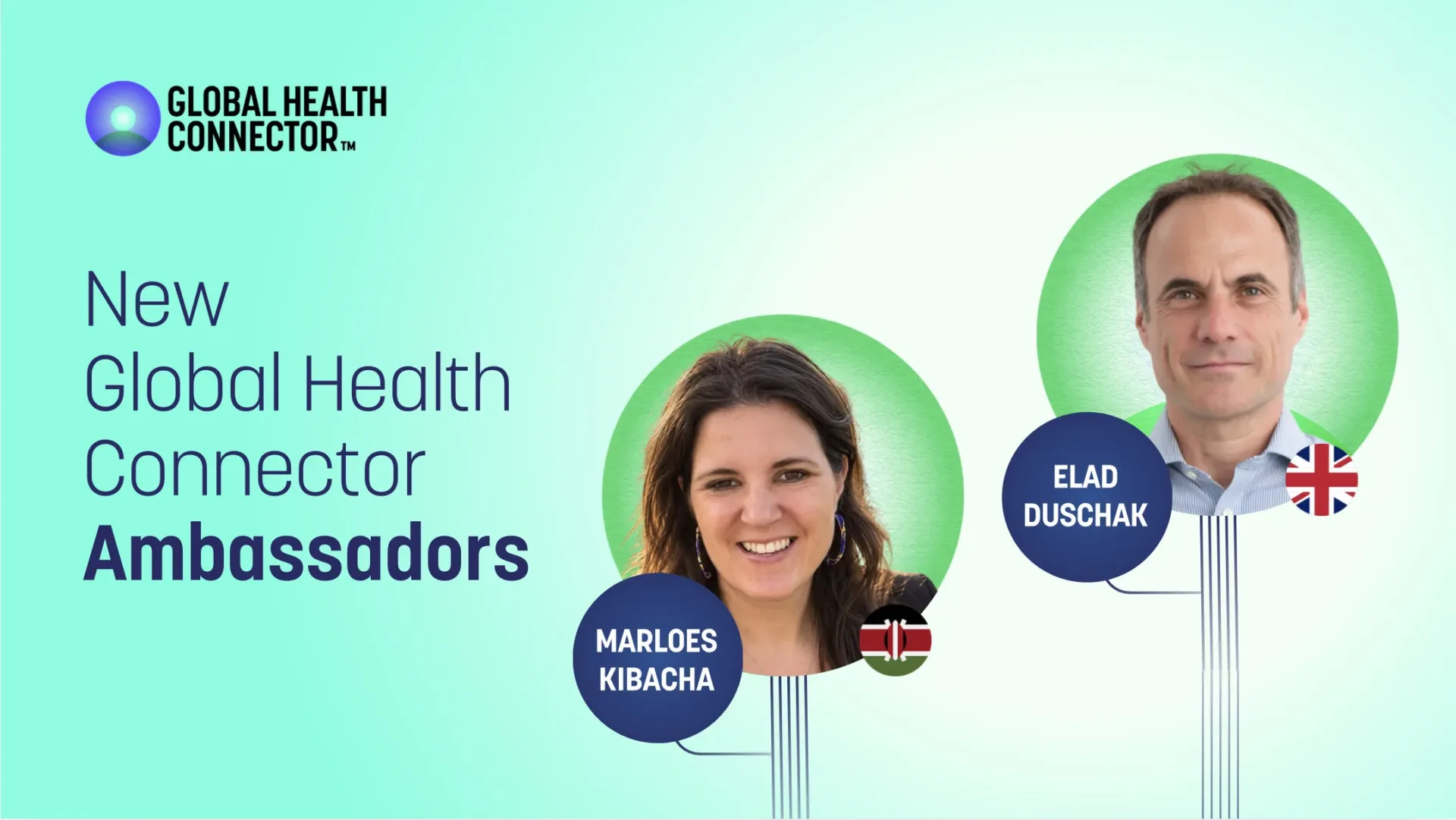
We are pleased to welcome two new members to the Global Health Connector Ambassador Circle: Marloes Kibacha, based in Nairobi, Kenya, and Elad Duschak, based in London, UK.
They bring years of experience in healthcare partnerships, investment, commercialisation and women’s health. They will help us build meaningful cross-border connections that improve health outcomes globally.
Marloes Kibacha is the Co-Founder and Managing Director of Africa Health Business (AHB), a pan-African healthcare advisory firm based in Nairobi, Kenya. Originally from the Netherlands, she has lived and worked in Africa since 2012, focusing on healthcare partnerships, market access, investment and private-sector engagement across the continent.
Marloes serves as Board Secretary of the Coalition for Women’s Health in Africa (COWHA), Board Member of the Sibusiso Foundation in Tanzania, supporting children with intellectual disabilities, and Founder and Board Member of the Imarika Initiative in Kenya.
Beyond healthcare, she is involved in agriculture and entrepreneurship through Beberu Farm, an avocado farming venture in Tanzania.
Elad Duschak is a healthcare and life sciences executive and strategic advisor with over 25 years of international experience driving commercialisation, business development, value creation and global growth across healthcare and technology-enabled businesses. He has worked with publicly traded corporations, start-ups and scale-ups backed by venture capital, private equity, strategic investors and family offices.
He began his career in consultancy providing primary market research and strategic insights to global pharmaceutical and medical device companies. He subsequently held senior leadership positions across the healthcare sector, including GM of a medical device innovator in orthopaedics; CEO of a global telehealth provider; and Chief Business Development Officer of one of the largest providers of primary care services in the NHS in England.
Elad currently serves as Senior Advisor on healthcare investments to a UK-based single-family office with £1.2 billion in assets under management and a global investment portfolio spanning direct equity investments and GP/LP positions in leading venture capital funds, accelerators and incubators across life sciences and medical devices, from early-stage through growth-stage companies. Alongside his investment activities, Elad advises pharmaceutical, digital health and medtech companies on commercial strategy and global market expansion, helping management teams translate innovation into scalable commercial opportunities.
He is also a Judge at medtech Innovator, the world’s largest medtech accelerator, and at the HealthInvestor Awards, recognising excellence and innovation across the UK healthcare sector. Born and raised in Tel Aviv, Israel, he has lived in France and the UK for over 20 years and is currently based in London.
What excites you most about joining Global Health Connector, and how do you see your role contributing to its impact?
Elad: “What excites me most is the opportunity to accelerate the implementation of impactful innovation at a time when health systems across the globe have an urgent need to deliver better care at lower cost and enhance their resilience. As an Ambassador, I’m looking forward to contributing to amplify more cross-border connections and facilitate sharing of best practices around innovation and excellence in healthcare delivery.”
Marloes: “What excites me most is the opportunity to connect people, organisations and ideas across continents. Having worked in Africa’s healthcare sector for many years, I have seen the enormous potential for international collaboration, but also how often promising opportunities struggle to convert into actual partnerships and implementation that can scale.
Through my role at Africa Health Business, I hope to contribute an African perspective, connect Global Health Connector’s international network with relevant stakeholders and opportunities across the continent, and equally help bring African expertise, innovations and experiences to the global stage. I strongly believe that collaboration should go both ways, with much to learn from the innovations and approaches emerging from Africa.”
What does effective cross-border collaboration look like in practice, and what are the biggest barriers?
Elad: “Effective cross-border collaboration must start with a mutual understanding of local cultures, beliefs and values, as well as the nuances of the respective healthcare systems. The biggest commercial barriers for scaling medtech and telehealth across borders are by and large universal and tend to be related to the fragmented nature of health systems, lack of clarity on market access, procurement and funding pathways, misalignment of incentives among key stakeholders, and the time and effort to drive behavioural change within frontline teams who are already stretched by their day jobs.”
Marloes: “For me, effective cross-border collaboration starts with understanding the local context and building relationships with the right partners. Africa is not one market. Every country has its own healthcare priorities, regulatory requirements, financing arrangements and ways of doing business.
Some of the biggest challenges we see are fragmented regulatory processes, lengthy procurement cycles, limited financing and reimbursement mechanisms, and, particularly for digital health, data governance and interoperability requirements. Beyond market entry, companies often underestimate what it takes to implement, maintain and scale solutions within existing health systems.
Successful partnerships require early engagement with local stakeholders, a realistic business model and a willingness to adapt solutions to local needs. Equally important is recognising African organisations as partners with valuable expertise and experience, and not only as entry points into new markets.”
Women’s health has long been underfunded. Elad, you have extensive experience commercialising women’s health biotech, particularly in menopause, an area historically overlooked by traditional capital. Marloes, you are a leading advocate for women’s health in Africa.
From your experience, where are the most urgent unmet needs, and what needs to change in how health leaders, governments and investors fund and deliver women’s health solutions?
Elad: “The most urgent shift is to stop viewing women’s health, particularly menopause, as a niche or ‘lifestyle’ category, and instead recognise it as a significant, underserved healthcare market with substantial clinical, economic and societal impact.
From my experience commercialising women’s health solutions, one of the biggest challenges is not necessarily a lack of innovation or unmet need, but the disconnect between the scale of the opportunity and how it is assessed by investors, healthcare leaders and adoption stakeholders. Menopause affects a very large proportion of women during a significant period of their lives, yet historically the healthcare system has not allocated capital, research attention or commercial resources proportionate to that need.
Investors and health leaders therefore need to shift from asking, ‘Is this a women’s health niche?’ to asking, ‘What is the size of the unmet need, who ultimately pays for addressing it, and what measurable outcomes can this solution deliver?’ That means looking beyond the traditional healthcare market opportunity and quantifying the broader value: improved quality of life, productivity, reduced healthcare utilisation, earlier intervention and better long-term health outcomes.
The second shift is from funding innovation to funding adoption. A clinically compelling solution will only create meaningful impact if there is a clear pathway to reimbursement, clinical integration, distribution and patient access. Entrepreneurs and investors need to build the commercialisation strategy much earlier, with evidence generated not only around clinical efficacy but also around economic value and real-world adoption.
Ultimately, I believe the opportunity is to move women’s health from a historically underfunded category to a mainstream healthcare investment and innovation sector. That requires capital providers and health systems to recognise the scale of the unmet need, apply rigorous commercial and clinical criteria, and invest in solutions that can demonstrate both meaningful patient outcomes and a sustainable path to adoption.”
Marloes: “Women’s health remains significantly underfunded across Africa, particularly beyond maternal and reproductive health. While we still face major gaps in access to quality maternal healthcare and family planning, areas such as cervical and breast cancer prevention, screening and treatment also need much greater attention.
Through our work with COWHA, we see how important it is to bring governments, industry, investors and civil society together to address these gaps.
I would love to see women’s health recognised much more as an economic and development priority, with stronger domestic financing, greater private-sector investment and more attention to making existing solutions accessible and affordable. We also need to involve women themselves in determining healthcare priorities and designing services. Ultimately, investing in women’s health benefits families, communities and economies across the continent.”