
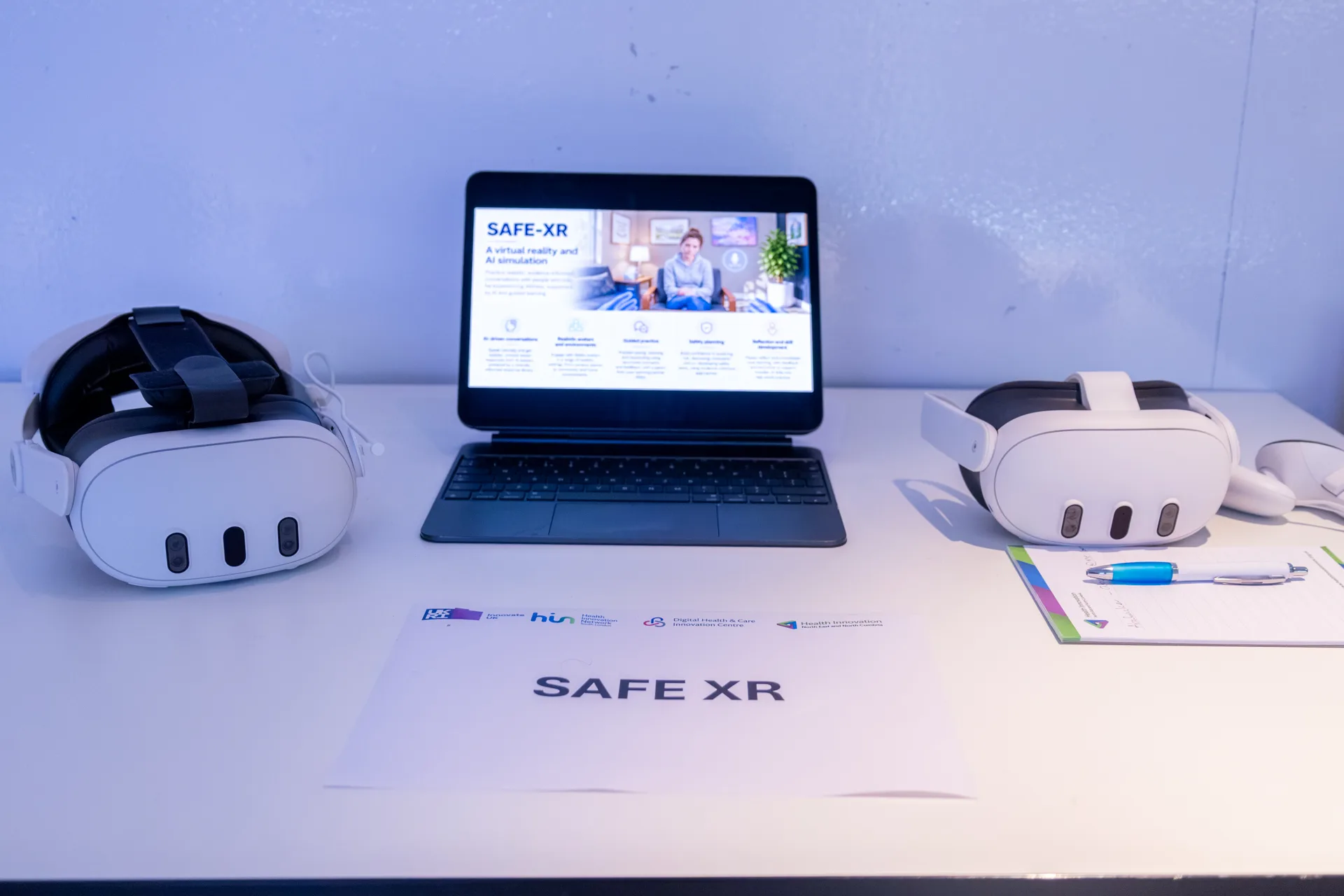
How could artificial intelligence (AI) and extended reality (XR) help professionals prepare for some of the most challenging conversations in mental health care? The Innovate UK-funded SAFE-XR project is exploring this question by combining immersive scenario-based learning, evidence-informed safety planning, and AI-supported feedback. Led by Scottish SME Care Reality, with the Digital Health & Care Innovation Centre (DHI) playing a key role in co-design, testing, and routes to adoption, SAFE-XR aims to strengthen professionals’ confidence in supporting people experiencing suicidal thoughts while also promoting workforce mental health and resilience.
SAFE-XR, an Innovate UK-funded project led by Scottish technology company Care Reality, is exploring how virtual reality simulations and AI-supported feedback could help professionals practise challenging conversations. The Digital Health & Care Innovation Centre (DHI) is supporting co-design, testing and future adoption, with a focus on evidence-informed learning, professional confidence and workforce wellbeing.
Professionals in health, social care, emergency services, education and community settings may encounter people experiencing suicidal thoughts. Responding with empathy and confidence can be challenging, and opportunities to practise sensitive conversations in a realistic but controlled setting may be limited.
The Safety Planning for Suicide Prevention XR (SAFE-XR) project aims to address this gap through Care Reality’s FLO extended reality (XR) platform. It is developing immersive virtual reality (VR) scenarios informed by evidence-based approaches to safety planning. These scenarios are intended to help learners rehearse responses, reflect on their decisions and build skills alongside existing training and supervision.
AI and machine learning are intended to analyse interactions during simulations and provide personalised learning feedback. This could help practitioners identify strengths and areas for development, rather than relying solely on a simulated experience without structured reflection. The proposed experience also recognises the emotional demands of suicide prevention work, including the need for self-care and signposting to appropriate mental health support. Its dual focus is therefore on learning to support others and recognising professionals’ own wellbeing.
SAFE-XR is led by Care Reality in collaboration with DHI, Public Service Delivery Scotland (PSDS) and the University of Glasgow’s Suicidal Behaviour Research Laboratory (SBRL). Each partner contributes expertise in technology, workforce learning, research or innovation.
DHI supports participatory co-design, bringing frontline practitioners and people with lived experience into the development process. Their perspectives can help make scenarios relevant, sensitive and grounded in the realities of supporting someone experiencing suicidal thoughts.
DHI is also supporting user testing and evaluation, helping the partnership gather feedback and identify improvements as the solution develops. Through Scotland’s Digital Mental Health Innovation Cluster, it can connect the project with relevant stakeholders in digital mental health, support knowledge sharing and contribute to discussions about implementation and potential wider use. This connects technology development with the perspectives of the health and care system.
Because suicide prevention is a sensitive area of practice, the project emphasises credible evidence, appropriate safeguards and meaningful involvement of those affected. SAFE-XR is intended to complement, not replace, face-to-face training, professional supervision or established support pathways. It is not designed to automate clinical judgement.
The partners plan phased testing and evaluation to explore usability and the solution’s potential contribution to practitioners’ skills, confidence and resilience. Feedback from users will help inform improvements and decisions about possible wider implementation. The project is still being developed and evaluated: these are intended outcomes, not yet demonstrated benefits. Evidence gathered through that process will be important in understanding where the approach may be useful and what further development it needs.
For health and care organisations internationally, the project raises a wider question: how can emerging technologies create meaningful opportunities for professional learning while protecting human connection and safety? SAFE-XR offers a Scottish example of collaboration between industry, researchers, practitioners and people with lived experience to explore that question.
https://www.dhi-scotland.com/projects/safxr%3A-safety-planning-for-suicide-prevention-xr
Organisation: Digital Health & Care Innovation Centre (DHI), Scotland
Author: Anna Whyte, Project Support Assistant