
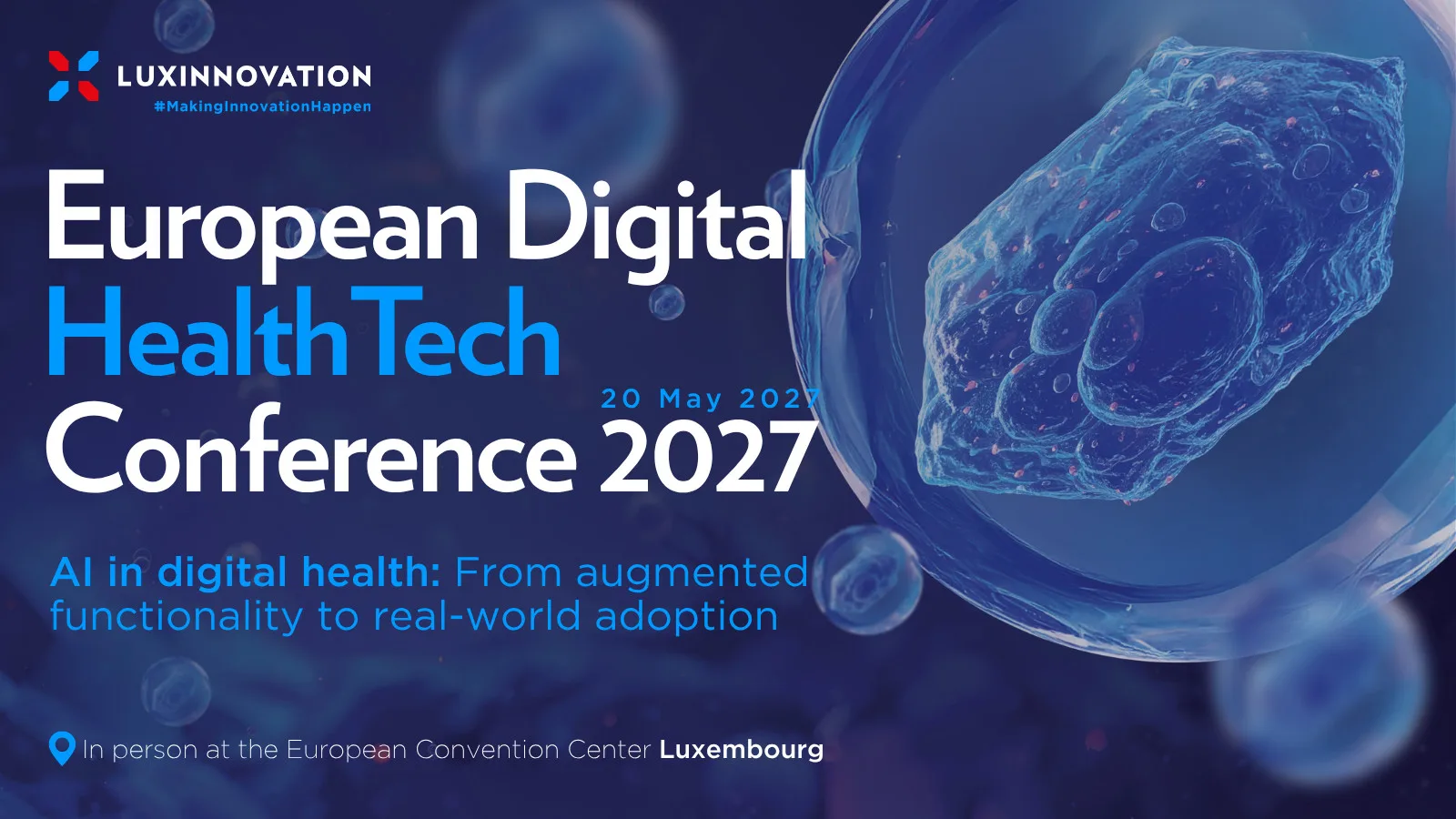
Artificial intelligence (AI) is reshaping healthcare, but technology alone does not create impact. Innovation grows where organisations have access to the right infrastructure, partners and networks. In Luxembourg, Luxinnovation helps build these connections, bringing together companies, researchers and healthcare stakeholders through international and local initiatives such as the European Digital HealthTech Conference 2027 or the national Joint Call AI-HPC to turn innovative ideas into real-world applications.
Healthtech and AI share an important common denominator: trust matters. Healthtech companies need secure environments for handling sensitive patient data. They need access to advanced computing resources and partners who understand the challenges and regulations involved in bringing innovation to market.
Since making healthtech innovation a strategic priority in 2008, Luxembourg has been building the foundations to support this journey. At the heart of the ecosystem is a tight-knit community of healthtech companies, public research organisations, healthcare providers, innovation support actors, digital infrastructure providers and ultimately, patients. The result is an environment where people know each other, connections happen quickly and promising ideas can move faster from concept to application.
More than 130 healthtech companies are active in this ecosystem, around half of them focused on digital health solutions. Businesses can connect with the right partners, collaborate across disciplines and find opportunities to grow.
Digital sovereignty is an important part of the equation. As AI becomes more deeply embedded in healthcare, healthtech companies and their clients need confidence that their data, computing resources and digital tools remain secure, reliable and accessible.
Luxembourg offers companies a comprehensive environment for developing AI-driven healthcare solutions. LETZDATA – Luxembourg Data Factory, provides governance and data access as a national initiative, bringing together stakeholders to enable trusted reuse of public sector data. Stakeholders such as the Luxembourg National Data Service (LNDS) support the implementation through data services, and sovereign Tier IV cloud infrastructure from LuxConnect (CLARENCE) and DEEP-POST Luxembourg, or supercomputing capabilities of MeluXina, together bring resources to help organisations explore, develop and scale AI-driven healthcare solutions.
As Ariane Scheuren, PhD, Senior Advisor HealthTech at Luxinnovation, explains:
“Successful AI innovation in digital health solutions requires more than technology. It depends on trusted infrastructure, access to expertise and strong collaboration between companies, researchers and healthcare stakeholders to build meaningful solutions that ultimately benefit patients. Luxembourg has deliberately invested in all of these elements to help innovations create value beyond the development stage.”
The strength of this ecosystem has now been recognised by the World Health Organisation (WHO): Luxembourg has been selected to host the future geographically dispersed WHO/Europe office dedicated to artificial intelligence in health. The office’s primary role will be to assist European countries in integrating safe, ethical, and trustworthy AI into their healthcare and public systems.
One example of this collaborative approach is the Joint Call AI-HPC, launched in spring 2025 by the Ministry of the Economy, the National Research Fund and Luxinnovation. It supports organisations established in Luxembourg that are looking to develop projects using artificial intelligence, high-performance computing or a combination of both.
The response highlights the strength of the ecosystem and its appetite for collaboration. Seventeen public-private partnerships submitted proposals, and nine projects were selected for co-funding.
Four of those projects come from the healthtech sector, demonstrating how organisations across Luxembourg are using AI to tackle real health-related challenges:
These projects tackle different healthcare challenges. What they share is a collaborative approach that brings together expertise from across the ecosystem. Building on this 2025 experience, the initiative expanded in 2026 to include data and quantum technologies. The resulting Joint Call Data-AI-Quantum remains open to healthtech companies and will continue in the same format in 2027.
Innovation in healthtech is ultimately about people. New ideas gain momentum when organisations share knowledge, challenge assumptions and learn from one another. That is exactly what makes Luxembourg’s healthtech community so valuable.
This spirit of collaboration is also at the heart of the European Digital HealthTech Conference 2027. Bringing together innovators, healthcare professionals, researchers, policymakers and investors from across Europe, the event will explore why AI has become a common feature in digital health innovation, yet routine adoption across healthcare systems remains limited.
It is an opportunity to meet the people behind Europe’s next generation of digital health solutions, exchange ideas and build new connections across the community. Registration is now open here.