
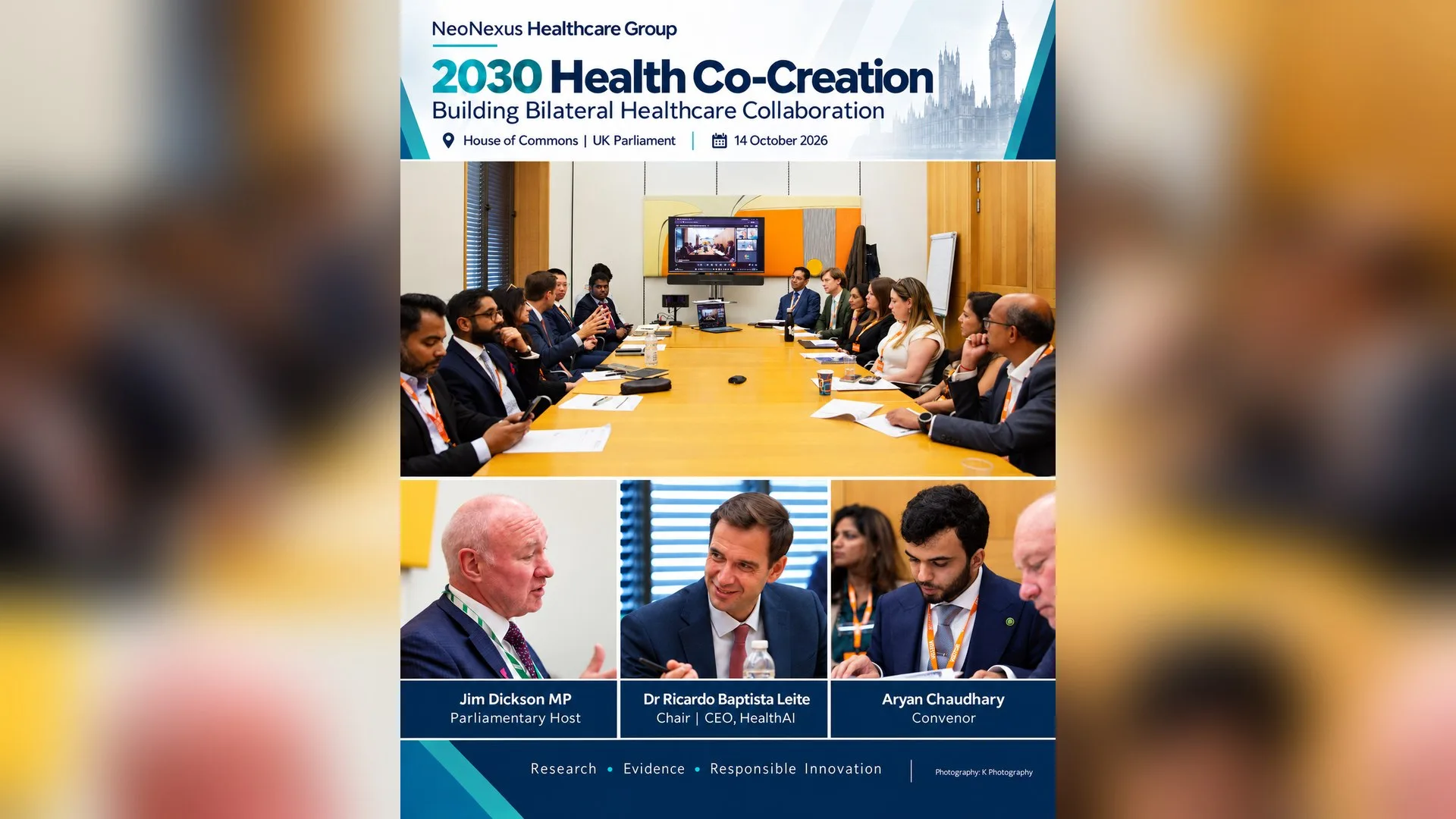
Insights from the 2030 Health Co-Creation roundtable at the UK Parliament on making healthcare AI work through reciprocal partnerships.
Aryan Chaudhary
Director & Chief Scientific Advisor
BioTech Sphere Research, India | A Unit of NeoNexus Healthcare Pvt Ltd
Healthcare AI needs a clear route from identifying risk to improving care. Drawing on the 2030 Health Co-Creation roundtable at the UK Parliament, Aryan Chaudhary explores how clinical evaluation, workforce readiness and reciprocal international partnerships can support responsible implementation. The next phase invites evidence and institutional contributions to a policy report and proposed Working Group.
An AI system may identify a suspicious retinal image or flag someone at risk of hypertension. Its practical value depends on what happens next. Can the person obtain a clinical assessment? Is treatment available? Who follows up if they miss an appointment? These questions should shape the design of healthcare AI from the beginning.
They were central to the discussion and written contributions at our 2030 Health Co-Creation roundtable on 14 October 2026 at Portcullis House, House of Commons, UK Parliament. Convened by BioTech Sphere Research, India, a unit of NeoNexus Healthcare Pvt Ltd, the event brought together 68 participants in person and online. Jim Dickson MP hosted the roundtable, chaired by Dr Ricardo Baptista Leite, Chief Executive Officer of HealthAI.
Contributions on prevention emphasised the connection between screening, referral, medicines access and sustained follow-up. A proposed community hypertension collaboration illustrated this approach: begin with a defined population and existing services, then examine whether digital support helps people complete referrals and remain engaged in care.
This suggests a useful starting point for AI projects: map the patient journey before choosing the technology. A screening programme needs a receiving clinical service and a way to identify missed follow-ups. Its evaluation should examine whether those connections work, including for people without reliable internet, smartphones or confidence using digital services.
Participants also proposed a UK–India research partnership exploring AI-assisted diabetic retinopathy screening. This remains an opportunity for institutional scoping, rather than an established deployment. Its value would lie in jointly defining the clinical question, evaluation methods and responsibilities before introducing a tool into routine care.
A model tested in one setting should be assessed for the population and service where it is intended to operate. Relevant questions include performance across patient groups, the handling of uncertain results and the consequences of missed or incorrect referrals. Evidence of technical accuracy should be considered alongside clinical benefit, service workload and patient experience.
The discussion highlighted protected learning time, reliable infrastructure and role-specific skills. Healthcare staff need to understand how a tool fits their responsibilities, when to question its output and where to seek help. Organisations also need people who can connect clinical safety, evaluation, regulation and service improvement.
The World Health Organization’s 2021 guidance on ethics and governance of AI for health places human autonomy, accountability and equity among its core principles. In practice, our proposed approach would give each collaboration a named clinical lead, defined human oversight, a route for reporting problems and criteria for reviewing or pausing use. These arrangements should be understandable to the people delivering care.
The 2030 Health Co-Creation initiative seeks to connect strengths across countries around jointly defined healthcare needs. A useful corridor would bring together institutions with complementary expertise, agree a specific problem and establish how both sides contribute and learn. Local context, appropriate data governance and sustainable financing need attention from the outset.
We are now inviting contributions to a policy report and expressions of interest in a proposed Working Group. The aim is to refine five to seven policy messages and select two or three collaboration opportunities for deeper exploration, supported by a 30–60–90 day roadmap. Publication will follow evidence, factual and attribution review.
The roundtable was approved as a pre-event in the Road to Geneva programme leading to the Geneva AI Summit 2027. Our contribution to that dialogue will focus on the practical work of implementation: clear responsibilities, appropriate evidence and partnerships that remain accountable to patients and communities.
Policy contributions and Working Group expressions of interest are welcome by 30 November 2026 at chaudhary.aryan@biotechsphereresearch.com.
Visit NeoNexus Healthcare Group: neonexushealthcaregroup.com