
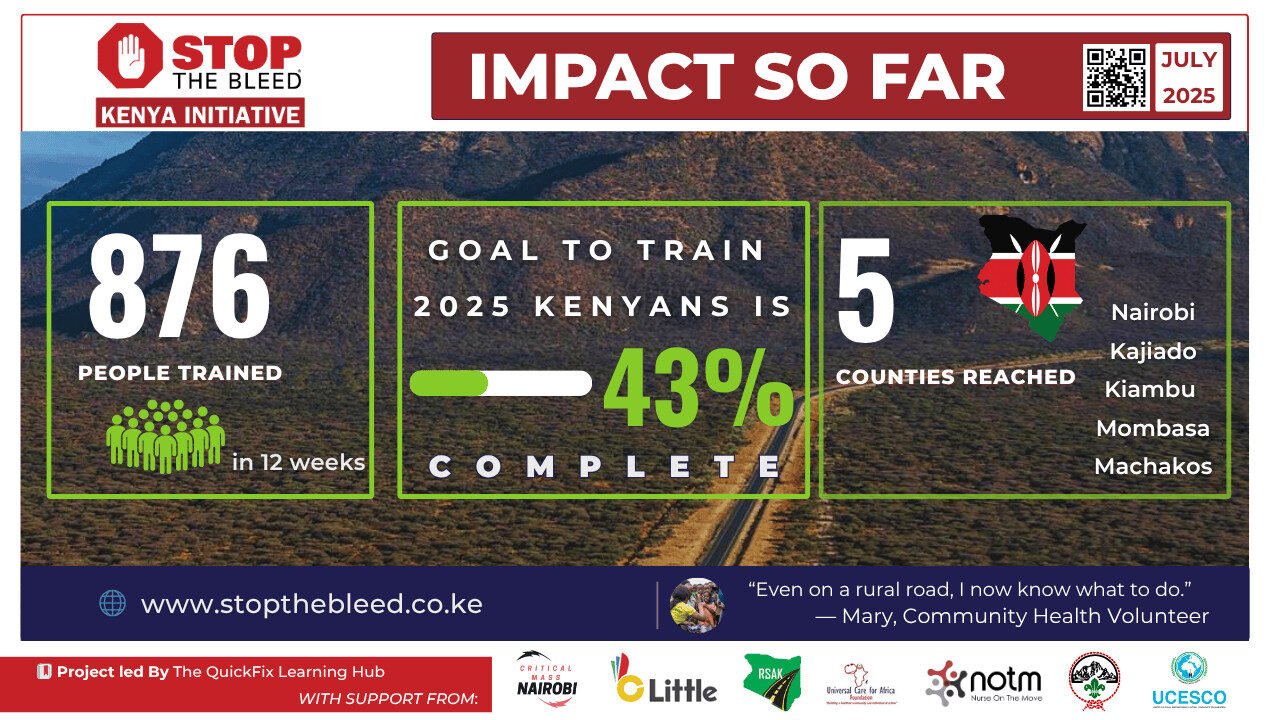
In this news piece, readers will learn how the STOP THE BLEED® Kenya Initiative has rapidly trained 876 people in just 12 weeks - empowering everyday Kenyans with critical bleeding control and first -response skills. The article highlights our community-based model, real - world impact, and the urgency of addressing Kenya’s high rate of road crash fatalities. It also outlines our growing digital efforts and call for strategic collaborators to help scale this life - saving initiative nationally and beyond.
Every day in Kenya, 13 people lose their lives in road crashes, according to the National Transport and Safety Authority (NTSA). Many of these deaths occur not from the crash impact, but from uncontrolled bleeding – within minutes – before professional help arrives. In response, a fast-growing movement is turning ordinary Kenyans into first responders: STOP THE BLEED® Kenya, led by The QuickFix Learning Hub.
In just 12 weeks, this initiative has trained 876 people across five counties, equipping teachers, boda boda riders, caregivers, students, security staff, and informal workers with hands-on, trauma-informed bleeding control skills. The results are transformative: people are no longer just bystanders – they’re prepared, confident, and able to act in the crucial minutes before medical help arrives.
“Our goal is simple but urgent: no one should die just because the person next to them didn’t know what to do,” says William Kimanzi, Founder of The QuickFix Learning Hub and National Coordinator of STOP THE BLEED® Kenya.
STOP THE BLEED® Kenya is designed for impact at the last mile. The training model is:
Sessions focus on recognizing life-threatening bleeding, applying direct pressure or makeshift tourniquets, and taking safe, confident action to keep victims alive until help arrives. Many trainees have already reported using their skills to save lives in real emergencies.
While STOP THE BLEED® Kenya remains deeply rooted in on-the-ground engagement, the team recognizes the opportunity for technology to exponentially scale impact.
“We have not yet integrated AI or mobile learning tools into our delivery model – but we are actively seeking individuals and organizations to help us do so,” Kimanzi emphasizes.
Their roadmap includes:
If you’re a health tech innovator, digital educator, or AI solutions provider – STOP THE BLEED® Kenya is ready to partner and co-design what scalable, African-led emergency education should look like.
With just five months left to reach their 2025 goal of training 2,025 Kenyans across all 47 counties, the initiative is 43% complete and rapidly expanding. To sustain momentum, STOP THE BLEED® Kenya is calling on:
“We’re not building a project. We’re building a national emergency response culture – from the ground up,” says Kimanzi.
To partner, contribute, or invite STOP THE BLEED® Kenya to your school, workplace, or community:
🌐 Visit: https://stopthebleed.co.ke
📩 Email: impact@stopthebleed.co.ke
The STOP THE BLEED® Kenya Initiative is a citizen-focused, community-first emergency response program hosted by The QuickFix Learning Hub. We train everyday Kenyans to stop life-threatening bleeding and save lives before help arrives. Our work aligns with Kenya’s public health goals and the UN’s call for stronger community resilience under the Sustainable Development Goals.
🔗 https://stopthebleed.co.ke 📬 impact@stopthebleed.co.ke
Discover more about QuickFix Learning Hub:
The QuickFix Learning Hub is a Kenyan social enterprise committed to democratizing life – saving knowledge through accessible, context -driven first aid training.
As the host of the STOP THE BLEED® Kenya Initiative, we focus on equipping vulnerable and underserved communities — especially those impacted by road crashes — with the skills and confidence to save lives before professional help arrives. Our programs are trauma-informed, hands-on, and data-driven, aligning with Kenya’s public health priorities and global Sustainable Development Goals. Since launch, we have trained hundreds and continue to scale through strategic partnerships, digital innovation, and community-based delivery.