
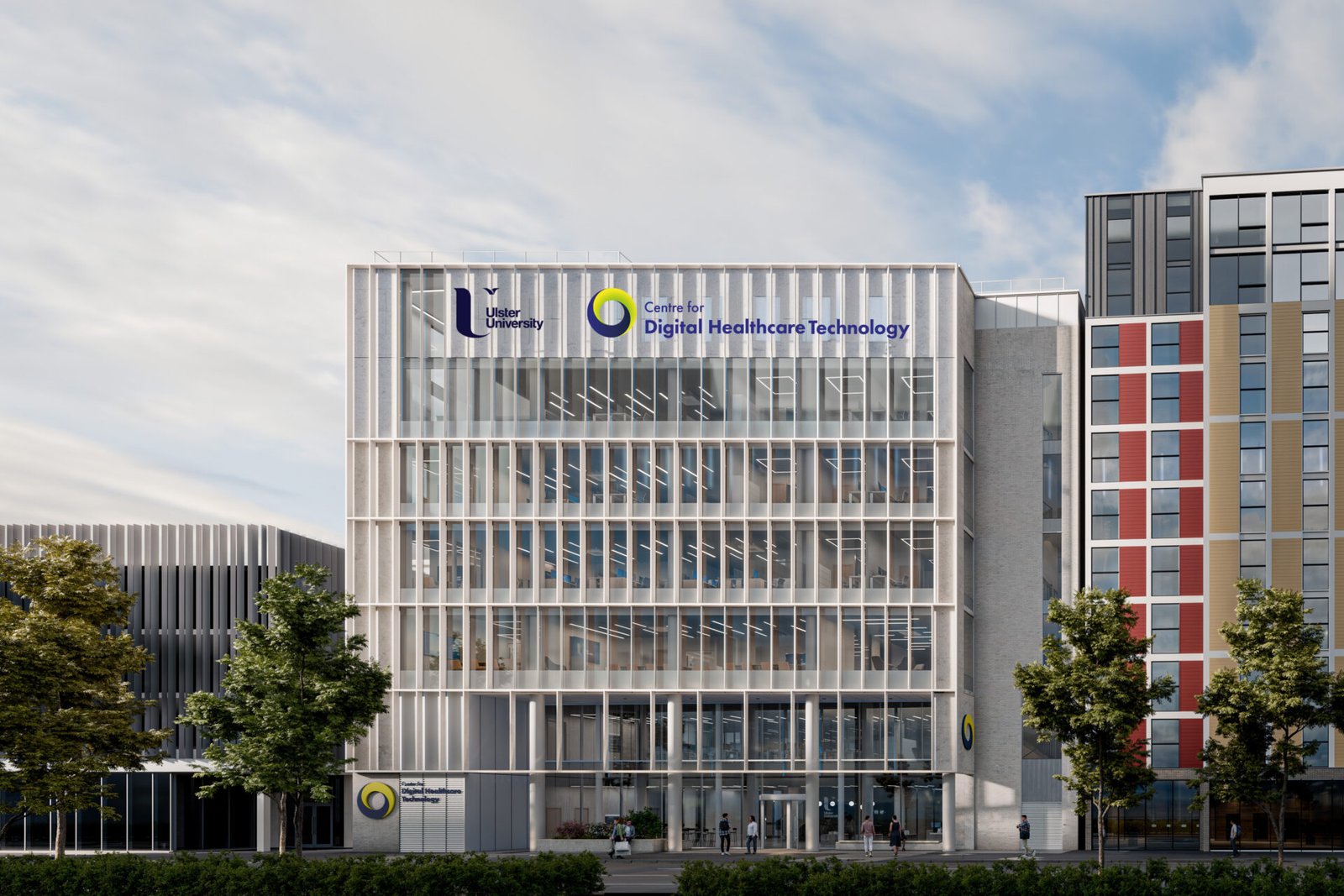
As global healthcare systems face rising demand, constrained resources, and growing expectations for personalised care, advanced wireless technologies are becoming a critical enabler of transformation. In the Centre for Digital Healthcare Technologies (Ulster University) , research led by Dr Cheema is exploring how 5G and emerging 6G networks combined with AI and quantum- inspired approaches are supporting how healthcare delivery is changing.
A fundamental challenge of how to design future wireless systems that are not only faster and more intelligent, but also reliable, safe, and inclusive is being developed. The focus is on translating advances in wireless communications, machine learning, and sensing into real-world solutions, validated through practical deployments across healthcare and related domains.
5G has already demonstrated its potential to support low-latency, high-reliability connectivity within healthcare for remote monitoring, real-time video transmission, and non-contact sensing. Building on this foundation, CDHT research looks ahead to 6G, where intelligence, sensing, and communication are tightly integrated. This evolution shifts wireless networks from being passive data pipes to active participants in learning and decision-making.
A notable contribution is the development of machine-learning models that operate effectively under limited computational and energy constraints, a reality in many healthcare environments. These models are designed to support applications such as RF-based health sensing and exposure-aware network planning, ensuring that wireless systems can scale safely as healthcare becomes more connected.
A current project underway is an experimentally validated, non-contact wireless solution aimed at preventing pressure ulcers. By combining RF sensing with intelligent data analysis, the system enables continuous monitoring without intrusive devices, demonstrating how wireless technologies can support preventative and patient-centred care. Complementing this, the team has developed some of the earliest comprehensive machine-learning models to quantify and predict wireless exposure and its potential health implications. These models provide evidence- based tools for safer network design and more informed policy decisions.
Looking further ahead, the research introduces quantum machine learning as a strategic capability for future 6G systems. Two pioneering frameworks: one for multi-user 6G networks and another for air-quality modelling in the context of healthy ageing, offer structured methodologies for applying quantum computing to system design, optimisation, and performance evaluation. While large-scale quantum hardware remains limited, quantum-inspired approaches already show promise in enabling faster, more robust learning across complex and data-constrained healthcare scenarios.
For healthcare leaders, the implication is clear: as networks grow more complex and data volumes expand, classical optimisation alone may not suffice. Quantum-assisted intelligence offers a pathway to more adaptive, resilient, and efficient digital health infrastructure.
CDHT is focused on impact and therefore our research work focuses on implementation. Research on private 5G networks demonstrates how dedicated wireless infrastructure can support secure, high-quality services in controlled environments such as hospitals. Projects enabling real-time video transmission from remote locations highlight the operational value of private 5G for clinical collaboration, training, and specialist access, capabilities that became particularly salient during and after the COVID-19 pandemic.
Despite the promise of research capabilities and impact focus, implementation remains complex. Healthcare adoption of 5G and private networks raises persistent challenges around data security, privacy, regulatory compliance, and integration with legacy clinical systems. Quantum machine learning adds further hurdles, including hardware maturity, interpretability, and alignment with existing data pipelines. Cost, spectrum access, and workforce readiness also shape the pace and equity of adoption.
The strategic lesson is that technology alone is insufficient. Real impact depends on cross- disciplinary collaboration, clinician engagement, and clear demonstration of clinical and operational value. 5G and 6G networks underpin a shift toward connected, data-driven, and preventative healthcare. By embedding intelligence, sensing, and safety into the wireless fabric, healthcare systems can become more resilient, inclusive, and responsive, turning connectivity into a strategic asset for long-term digital transformation.
Having clinical integration at the core of CDHT and partnership working with the Belfast Trust, we are creating the home for rapid technology development into clinically integrated solutions. CDHT welcomes international industry, research and health system partners to collaborate in shaping the next generation of digitally enabled healthcare technology.
To find out more about CDHT, please visit: www.cdht.tech