
Yesterday morning, Nashville’s civic and business community gathered — Chamber members, technology leaders, entrepreneurs, and yes, more than a few healthcare executives — and the most compelling conversation about community health came from two professional football clubs.
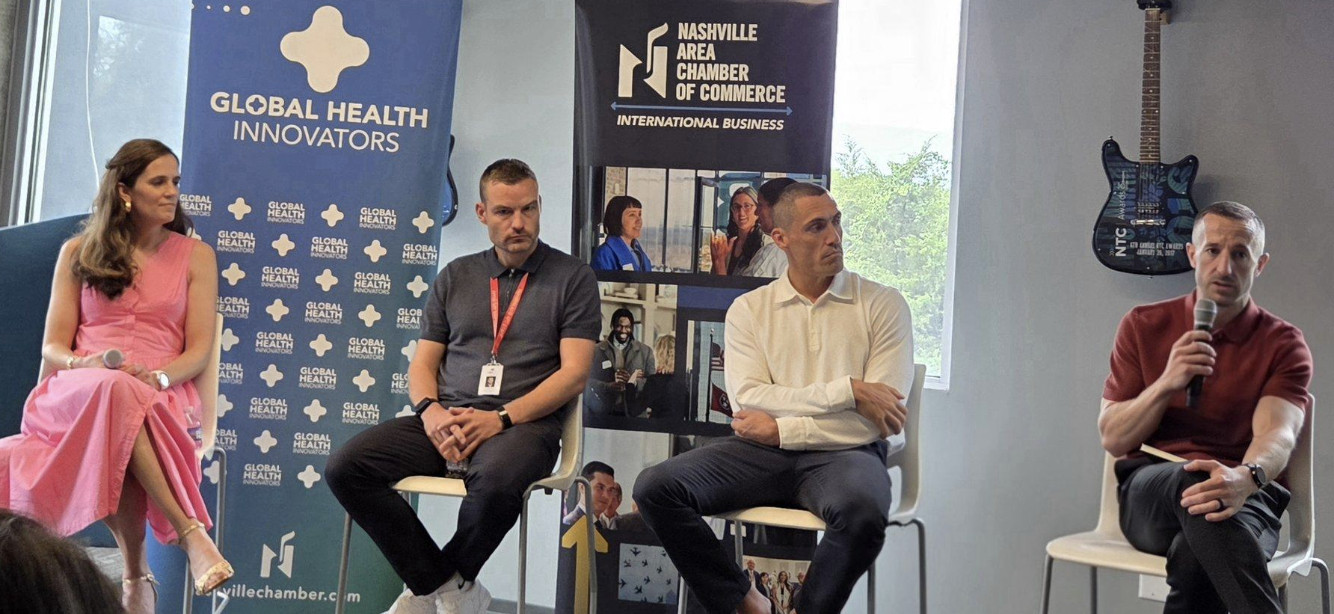
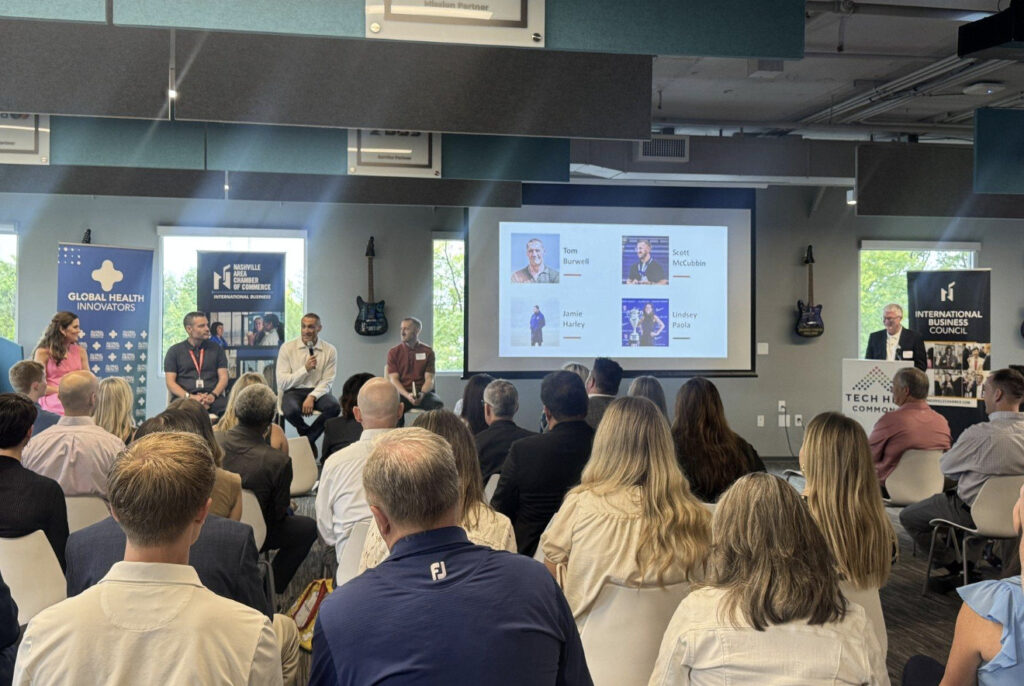
Global Health Connector and Global Health Innovators, in partnership with the Nashville Area Chamber of Commerce and the British Consulate-General Atlanta, welcomed the leadership of Sunderland AFC — CEO Tom Burwell, Chief Commercial Officer Scott McCubbin, and Head of First Team Performance & Medical Jamie Harley — alongside Nashville SC Chief Business Officer Lindsey Paola, for a moderated conversation about how clubs are redefining where health lives. Special thanks to the Greater Nashville Technology Council for hosting us.
The timing could not have been better. Sunderland is in Music City this week for the 2026 Summer Soccer Series, which kicks off Saturday at GEODIS Park against Liverpool, twenty- time champions of England. And both clubs arrived with form worth celebrating.
On the pitch, these are two organizations performing at the highest level. Sunderland just completed a remarkable first season back in the Premier League — a seventh-place finish and qualification for European competition — and sent twelve players to this summer’s World Cup, representing nine nations, the most of any club touring the U.S. this summer.
And here’s a stat Scott McCubbin shared that stopped me in my tracks: after the group stage of the tournament, of all the goals scored at this World Cup, Sunderland ranked third in goals scored by its players — behind only Real Madrid and Paris Saint-Germain. We’ll remember Messi, Mbappé, and Haaland, but the “team” performance behind the tournament belonged to three clubs — and Sunderland stood among them. Nashville SC, in its seventh MLS season, enters the weekend as reigning U.S. Open Cup champions, sitting atop the league table, riding a five-match winning streak after Wednesday night’s 1–0 win over Montréal — a run that included knocking Inter Miami out of the Concacaf Champions Cup this spring on the night Messi scored his 900th career goal. But the on-field success was the setup, not the story. The story was what these clubs are doing with the trust they’ve earned.
Here’s a truth gaining ground well beyond the health sector: health is not made primarily in hospitals and clinics. Education, income, housing, the built environment, social connection — these forces shape health outcomes and healthspan more powerfully than the care delivery system ever will. As the industry shifts its focus from treating illness to preventing it — from “healthcare” to health — the question becomes: where does health actually live? It lives where people already gather, trust, and belong — in our schools, our workplaces, our music venues, our galleries, and our stadiums. And that makes health everyone’s business: civic, commercial, and cultural alike.
Two organizations that understand this deeply were sitting on our stage.
Tom Burwell shared a number that explains everything that follows: 85 percent of Sunderland AFC’s employees live in Sunderland. This is not a club in a city; it is a club of its city. When the community hurts, the club feels it — because the club is the community. That’s the context for what Sunderland did in May. During Mental Health Awareness Week, the club temporarily replaced its iconic Black Cat emblem outside the Stadium of Light with a “Black Dog” — the centuries-old metaphor for depression famously invoked by Winston Churchill. Players walked out in Black Dog-themed shirts. The campaign stopped fans in their tracks by design.
The context matters: the North East of England records the highest suicide rate of any region in the country — and men account for roughly three in four of those deaths. The campaign pointed fans toward the Foundation of Light’s “Game of II Halves” program, which works with men 16 and over — the demographic most at risk and least likely to seek help, and precisely the audience a football club can reach when a clinic cannot. Think about what that is: a club taking its most sacred asset — its badge, its identity — and deploying it as a public health intervention. That is prevention work no health system could replicate.
And the ambition doesn’t stop at the city limits. Scott McCubbin shared plans to build on the global platform created by the Netflix documentary Sunderland ’Til I Die — which introduced millions worldwide to the bond between this club and its people — and carry Sunderland’s message of community and wellbeing around the world. A story that began in a proud city in the Northeast of England is becoming a global export.
Nashville SC’s answer starts with a sobering statistic: before the pandemic, only 36 percent of Tennessee third-graders could read on grade level. Third grade is the hinge point — when children shift from learning to read to reading to learn — and literacy is one of the strongest long-term predictors of health, income, and opportunity. So the club built Kickstart to Reading: a nine-week incentivized program in which third graders who hit reading goals earn Nashville SC merchandise, match tickets, and in-person player visits, with club staff and executives volunteering as reading mentors. Now in its seventh year in partnership with Metro Nashville Public Schools and the Dollar General Literacy Foundation, the program reaches a record 22 schools and thousands of students who have logged more than 26,000 hours of reading. A club converting its most valuable currency — access to the team — into educational attainment is upstream health investment, whether or not anyone calls it that.
Jamie Harley offered the thread that tied it all together. As Sunderland’s Head of First Team Performance & Medical, his job is keeping elite athletes healthy — and his message was that the game is won off the pitch. Advanced analytics and data tracking matter, but what they consistently reveal is that performance is driven by the fundamentals: nutrition, rest, sleep, recovery, and human connection. Read that list again. It isn’t a training regimen — it’s a prescription for population health. Elite sport figured out years ago what the health sector is now racing toward: measure continuously, intervene early, and treat the “off the field” factors as the main event rather than an afterthought. The distance between optimizing a Premier League squad and helping a community live longer, healthier lives is shorter than we think. As Jamie made clear — it’s a lesson for us all.
Professional sports clubs hold something the health sector spends billions trying to build: authentic trust, emotional connection, and a weekly gathering of the community. Sunderland and Nashville SC are showing what happens when that trust is invested in mental health, literacy, youth development, and belonging — the true determinants of healthspan. And for the business and civic leaders in the room, the message was just as direct: every organization with community trust holds a health asset, whether it knows it or not.
Sport is one spotlight. It is not the only one. If you need proof that these intersections are real, look no further than what Sunderland will wear at GEODIS Park on Saturday. The club’s new away kit — pink and black, drawn from Elvis’s Cadillac and his Louisiana Hayride era — is the product of a first-of-its-kind, multi-year collaboration between a Premier League club and the Elvis Presley Estate. Why Elvis? Because “Can’t Help Falling in Love” has been Sunderland’s matchday anthem for nearly five decades, first sung on the terraces just days after The King’s passing in 1977, with the lyric now stitched inside the collar of every shirt. A football club from the Northeast of England, wearing its musical soul on its sleeve, debuting it in Music City. Sport, music, culture, and community identity — woven into one garment. “Some things are meant to be.”
This conversation was a preview of the larger idea behind Global Health Innovators Summit III — “Where Health Lives.” — coming September 16 to The Cannery in Nashville. GHIS III convenes at the intersection of health with art, music, culture, and sport — the places where communities actually form identity, find connection, and build wellbeing. In a city that runs on all four, there is no better place to explore what happens when the creative and civic forces that shape daily life are recognized as the health
infrastructure they truly are. Yesterday, two football clubs showed us what that looks like in practice. In September, we widen the lens.
Because as this week made clear: health doesn’t just live in hospitals and clinics. It lives beyond the pitch — and on it, and in the gallery, the writers’ room, and the concert hall.