
Imagine needing life saving health information but not understanding the language it’s delivered in. For millions across Africa trying to access digital information, this is the reality.
Digital health initiatives such as mobile health education apps and health chatbots are rapidly expanding across Africa, promising to revolutionize health care. Yet a structural barrier threatens their success: language. While technology increasingly shapes health communication, millions across the continent remain excluded because digital platforms overwhelmingly rely on dominant languages such as English or French, and text-heavy formats that exclude people with lower literacy. As a result, the gap in access to information widens for people who speak low-resource languages.
One major challenge is that written health information often fails to reach the most vulnerable. Research done by CLEAR Global showed the extent to which text based digital materials in dominant languages exclude people from aid, and the same lessons can be applied in health. In Somalia, for example, only about 36% of adult women are literate, meaning the majority cannot access text-based health information. Similar challenges exist in DRC. Research by CLEAR Global in 2019 suggested that for people in Goma, the local form of Swahili was the most effective language for risk communication and community engagement for the Ebola response as respondents did not understand key messaging in French and standard Swahili. Women over the age of 35 also had the greatest difficulty understanding Ebola messaging in these languages. Voice datasets enable speech technologies like Text-to-Speech (TTS) and Automated Speech Recognition (ASR), which would allow people to receive vital health instructions in audio form, in their own language. This is especially critical for maternal healthcare, where timely and accessible information can save lives.
Relying solely on dominant languages is insufficient for inclusive health programming. In Somalia, COVID-19 information was provided in Mahaa, and it was not understood by Maay speakers. Similarly, research conducted by CLEAR Global and Minority Rights Group found that Maay speakers did not understand polio vaccination information and were excluded from vaccination campaigns which were in Mahaa language. In the Democratic Republic of Congo, COVID-19 instructions in Congolese Swahili and French failed to reach populations who spoke other dialects such as Lingala, Nande, Bira, Hema and Lese. Another study to measure the comprehensibility of health related information on English posters vs translated swahili posters showed that content needs to be provided in languages of highest comprehension and in this case, swahili should have been used as the main language for communicating health information. These examples highlight the urgent need for voice datasets in underrepresented languages to enable inclusive health communications. Without foundational language data, inclusive AI models cannot be built, leaving millions unheard.
At its core, this challenge is a data crisis. Functional speech systems require annotated voice recordings and transcriptions, yet most of Africa’s 2,300+ languages lack such resources. While a few global languages enjoy robust digital support, African languages remain underrepresented, stalling the development of inclusive digital health. To achieve true digital health equity, investment must prioritize foundational language and voice datasets so that people can get the information they need in the language they speak. Community-driven initiatives, such as TWB Voice, show how local-language data collection can build the infrastructure necessary to ensure health information reaches everyone.
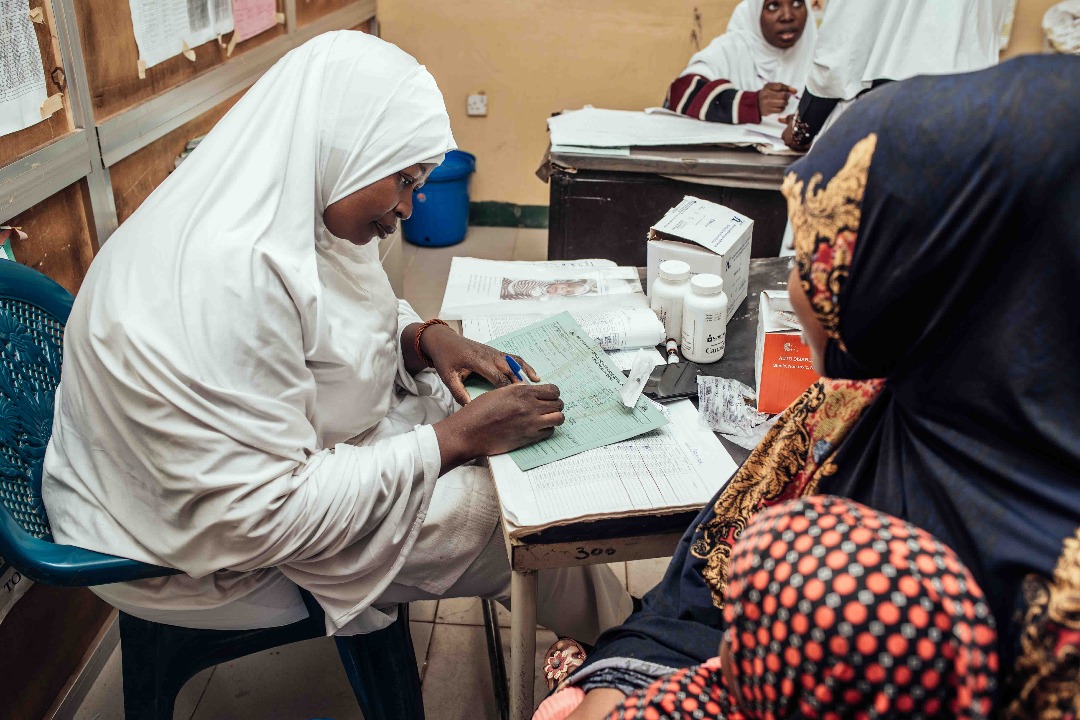
Photo by “WeMUNIZE, USAID Nigeria” by USAID Digital Development, CC BY 2.0.