
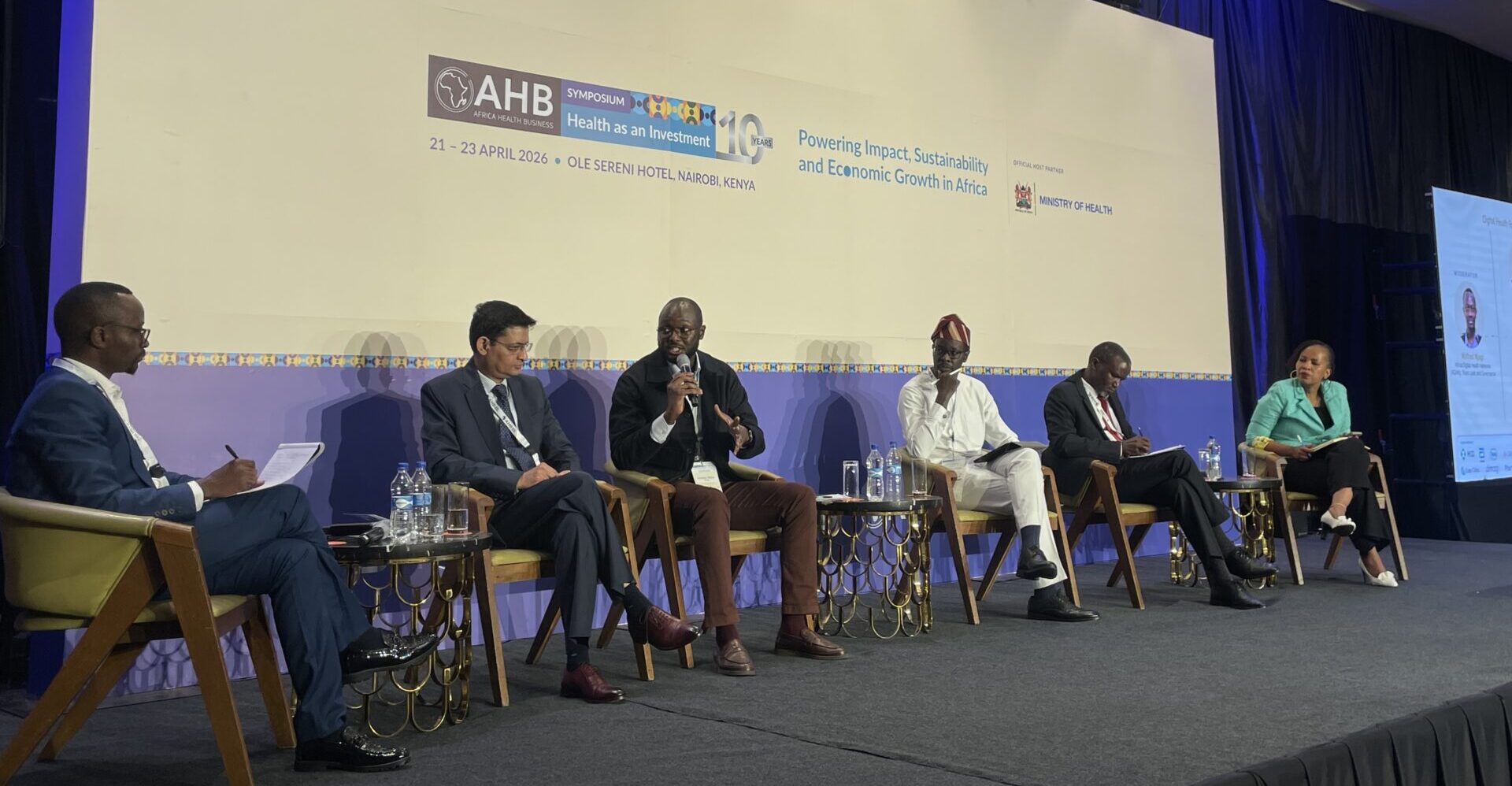
From innovation to investment-ready systems: this was the key message of the digital health session at the Africa Health Business Symposium 2026 in Nairobi.
Moderated by Wilfred Njagi, Team Lead, Governance at Africa Digital Health Networks (ADHN), the session brought together a diverse group of speakers from across the digital health ecosystem, including:
A strong theme throughout the session was the need to design solutions grounded in reality. Ismaïla Diène emphasised that empathy must be at the centre of digital health innovation: understanding the daily challenges of users and building solutions that respond directly to them. This includes a critical but often overlooked principle: systems must work offline first. Without this, many solutions risk excluding the very populations they are meant to serve. The conversation is moving beyond technology-led innovation towards solutions shaped by real-world needs.
At the same time, speakers stressed that digital health cannot be separated from its business model. Willy Soriney noted that funding is available, but the real challenge lies in aligning innovators and investors. Too often, innovators want to retain full control, while financiers expect clarity on equity, returns and market models. Without this alignment, even strong solutions struggle to scale. This perspective was echoed by Priscilla Muhui, who highlighted the importance of combining digital and physical models, and continuously expanding services to build sustainable businesses rather than standalone solutions.
Artificial intelligence featured prominently in the discussion, but with a pragmatic lens. Girish Mohata highlighted the scale of the challenge: Sub-Saharan Africa carries around 25% of the global disease burden with only 3% of the healthcare workforce — a gap that cannot be addressed simply by increasing staffing. AI has the potential to support clinical decision-making, optimise supply chains and provide actionable insights for healthcare managers. However, its impact depends on the maturity of the system. Where data is fragmented and infrastructure weak, even the most advanced tools will struggle to deliver value.
This brought the discussion to the enabling environment. Johnpaul Omollo described digital health as both an enabler and, at times, a distraction, particularly in fragmented systems. Today, many countries face multiple regulatory frameworks, inconsistent technical requirements and limited interoperability between systems. Moving forward will require stronger regulatory harmonisation and convergence, as well as greater collaboration across countries and institutions. He also highlighted the importance of building technical capacity among regulators and creating sandbox environments where innovators and regulators can work together to test and refine solutions in practice.
Across all contributions, the importance of data remained central. Data underpins decision-making, surveillance, research and development, but it is also key to building trust. For digital health solutions to attract investment, they must demonstrate clear impact and transparency. Even where technologies such as AI offer significant value at relatively low cost, investment decisions ultimately depend on confidence in outcomes and the ability to show measurable results.
The session demonstrated that we are currently in a different phase of the digital health development: The challenge is no longer to prove that digital health works, but to integrate it into health systems and make it sustainable at scale. This requires solutions that respond to real needs, viable business models, stronger regulatory and data ecosystems, and collaboration across stakeholders.