
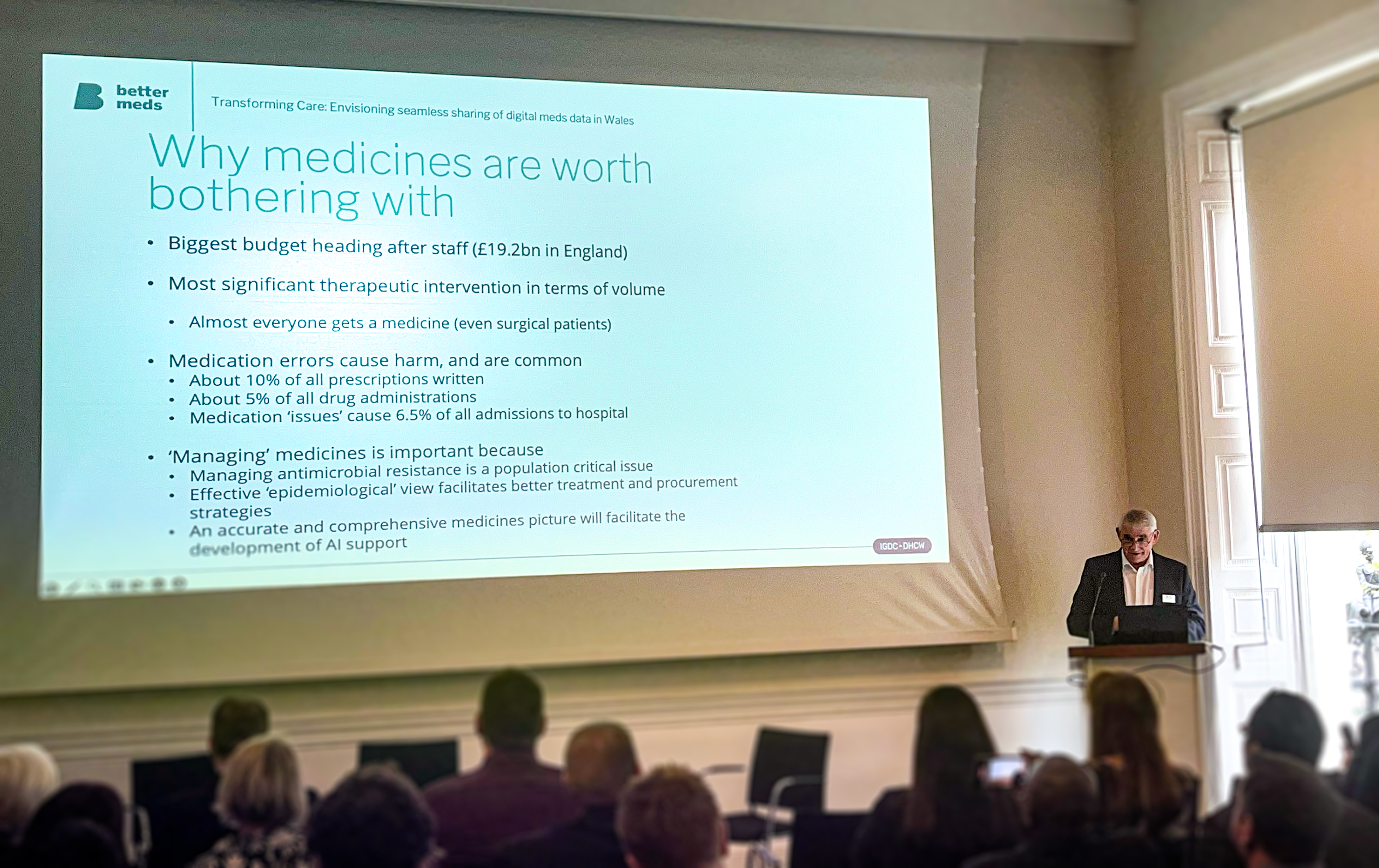
At our Better Meds community event in April, Keith Farrar, Deputy SRO at DHCW, presented the shared digital medicines record vision for Wales. He provided some reasoning for why it is worthwhile to invest in medicines:
The medication journey involves numerous interactions with various applications and systems, even for the same patient and the same medicines. In acute care, medication data is constantly being transferred between different settings. This creates several medication data silos that must exchange information efficiently to ensure continuity and accuracy of care.
The shared medication record will be a centrally held FHIR store populated by all significant medicine events in any approved healthcare system across the country. Data will be pulled from secondary, tertiary, community, and primary care, along with citizen systems and wider services such as social care, care at home, care homes, private care and hospices. It will record every new prescription, prescription update, dispense, and administration for each patient and make it available to health and care professionals in a context-specific way at the point of need.
Creating a shared medication record revolves around the adoption and implementation of robust standards. These standards include patient identifiers, organisation identifiers, encounter context, user identifiers, medicine identifiers, and meta-data codes (such as dosage information). Additionally, message structures and behaviors are defined using FHIR. The key to success lies in achieving interoperability and widespread adoption of these standards. Interoperability enables all healthcare systems to connect seamlessly through a unified set of APIs, ensuring that medication data can be accurately and efficiently shared across different platforms and care settings. This standardised approach is essential for creating a cohesive and reliable medication record accessible to all healthcare professionals when needed.
As Keith remarked, standards are essential because computers require precise instructions to process and exchange information effectively, ensuring consistency and reliability in data handling.
The envisioned benefits of the project are:
This topic was presented at our community event in April. For insight into other interesting topics we discussed, you can download the report below.
Better transforms healthcare organisations with Better platform, an open data digital health platform, designed to store, manage, query, retrieve, and exchange structured electronic health records, Better Meds, electronic prescribing, and medication administration solution, and the low-code Studio, which allows applications to be built rapidly at a fraction of the cost. The company focuses on simplifying the work of health and care teams, advocates for data for life, and strives for all health data to be vendor-neutral and easily accessible. It puts organisations in control of their data, workflows, and transformation plans in order to improve patient care. Better has provided solutions across more than 20 markets all over the world, among them being the UK, Spain, Sweden, Italy, Finland, Greece, Malta, Nigeria, Thailand, Indonesia, and others. The Better platform securely supports over 30 million patients.