
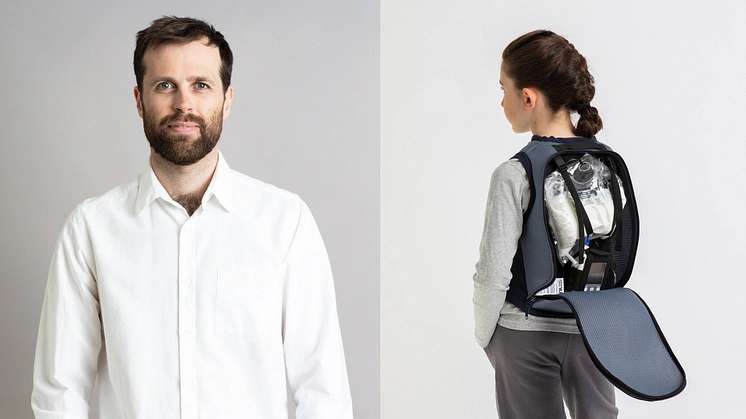
The Nil Medical Vestpack developed by the Swedish medtech company Nil Medical AB represents a shift in pediatric oncology care: from focusing solely on medical outcomes to also prioritizing the child’s lived experience during treatment.
Undergoing cancer treatment as a child is physically and emotionally demanding. Long hospital stays, repeated intravenous (IV) therapies, and constant connection to medical equipment can significantly affect a child’s daily life. In response to these challenges, Swedish medtech company Nil Medical AB developed the Nil Medical Vestpack — an innovative solution designed to improve mobility, comfort, and quality of life for children receiving advanced medical treatment.
The Vestpack represents a shift in pediatric oncology care: from focusing solely on medical outcomes to also prioritizing the child’s lived experience during treatment.
Children undergoing cancer treatment often rely on continuous or repeated IV infusions. Chemotherapy, antibiotics, fluids, and nutrition are typically administered through infusion pumps attached to a traditional IV pole.
While medically effective, this setup presents several limitations:
For children, movement and play are not optional activities — they are essential for development, emotional resilience, and well-being. Restricting mobility during prolonged treatment can negatively affect both mental and physical health.
The Nil Medical Vestpack was created to address this problem.
The Nil Medical Vestpack is an ergonomically designed medical vest that allows infusion pumps and associated equipment to be worn directly on the body instead of mounted on a stationary IV pole.
Developed by Nil Medical AB, the Vestpack is a CE-marked medical device designed with both safety and comfort in mind. It incorporates:
The result is a wearable system that enables children to move more freely while continuing their prescribed treatment.
Importantly, the Vestpack does not alter the medical therapy itself — it transforms the way the therapy is experienced.
One of the most significant benefits of the Vestpack is the increased mobility it provides. Instead of pushing or being followed by an IV pole, the child carries the equipment comfortably on their body.
This allows children to:
For children who may spend months in treatment, this freedom can have a substantial impact on daily life. Even simple actions — such as visiting a playroom, attending hospital school sessions, or moving independently in a corridor — contribute to a stronger sense of normalcy.
The Vestpack helps transform the hospital environment from a restrictive space into one where movement and activity remain possible.
Cancer treatment often affects how children see themselves. Constant attachment to medical equipment can reinforce the identity of being “a patient” above all else.
By integrating infusion equipment into a wearable vest, the visual and physical burden of treatment is reduced. The Vestpack contributes to:
Research in pediatric healthcare consistently highlights the importance of perceived control during illness. When children can move more freely and participate in daily activities, they are more likely to maintain emotional resilience.
In this way, the Vestpack supports not only physical mobility but also psychological stability.
Modern pediatric cancer care increasingly emphasizes quality of life as a core treatment goal. Survival rates have improved significantly over the decades, shifting focus toward how children experience treatment and recovery.
The Nil Medical Vestpack aligns with this approach by:
Rather than being a purely technical device, the Vestpack reflects a broader philosophy: effective care must consider the whole child, not just the disease.
Many medical devices prioritize functionality above all else. The Vestpack demonstrates that safety and empathy can coexist in product design.
Its development involved input from children, parents, and healthcare professionals. Core design principles included:
The ambition behind the name “Nil” reflects a simple yet powerful idea — that the vest should feel like almost nothing, allowing children to focus less on equipment and more on living their daily lives.
This human-centered approach distinguishes the Vestpack within the medical technology landscape.
Although developed with pediatric oncology in mind, the need for mobility during infusion therapy extends to other medical contexts, including:
As healthcare systems worldwide continue shifting toward patient-centered care models, wearable infusion solutions like the Vestpack have strong international relevance.
By improving everyday treatment experiences, such innovations can contribute to more sustainable and compassionate healthcare delivery.
The Nil Medical Vestpack may appear to be a simple concept — a wearable vest for infusion pumps — but its impact can be profound.
By replacing or reducing dependence on traditional IV poles, it restores:
In pediatric cancer care, preserving quality of life during treatment is not secondary to medical success — it is part of it. Children who can move, play, and feel a degree of normalcy are better supported emotionally and socially throughout their treatment journey.
The Nil Medical Vestpack illustrates how thoughtful, patient-centered design can meaningfully improve healthcare experiences. It is a reminder that innovation in medicine is not only about new drugs or advanced technologies — sometimes, it is about reimagining everyday challenges in ways that restore humanity to care.
And for children facing cancer, that difference matters deeply.