
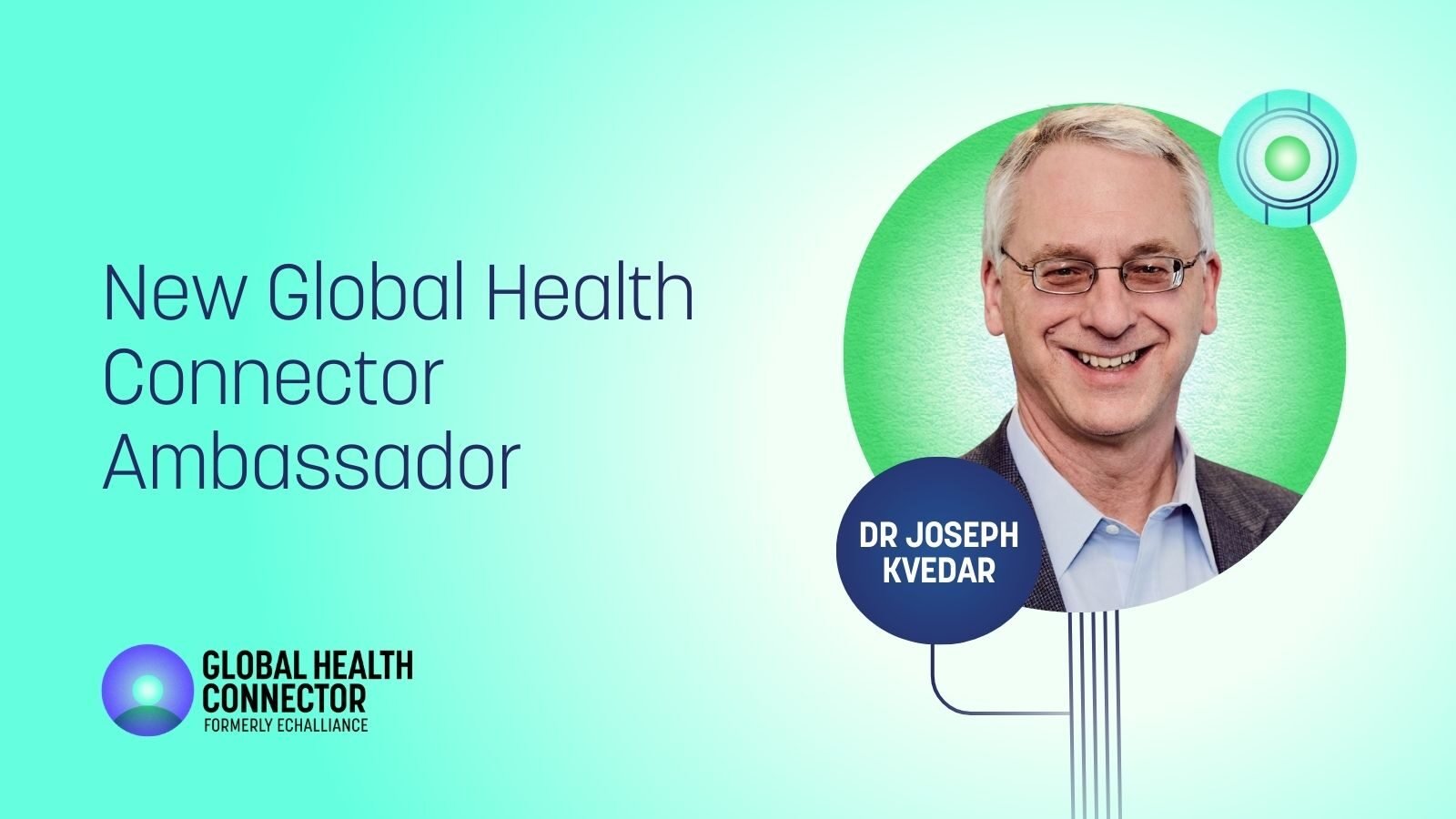
We are pleased to welcome Dr Joseph C. Kvedar as the newest Ambassador of the Global Health Connector. His addition further strengthens and expands the GHC Ambassador community.
Our Deputy Chair, Bleddyn Rees, commented on the announcement:
“Joe has made a vital contribution to the development of what today is known as digital health. Attending his Partners Connected Health Symposium in Boston was, for me, the most exciting event of the year and the best place to discover the latest innovations and ideas. He has that rare skill to explain the most complex medical and technical subjects and to provide strategic insight in simple, understandable words. A Harvard Professor, clinician, author, and Editor-in-Chief at npj Digital Medicine, we are honoured to have him as our Ambassador and to help us not only in our activities in the United States but also globally.”
Dr Joseph C. Kvedar, MD, is Professor of Dermatology at Harvard Medical School, Editor-in-Chief of npj Digital Medicine, and a Senior Advisor at the American Telemedicine Association.
He is co-chair of the American Medical Association’s (AMA) Digital Medicine Payment Advisory Group (DMPAG), which works to ensure widespread coverage of telehealth and remote patient monitoring, and successfully established several new provider codes for telehealth reimbursement through the CPT process.
Dr Kvedar is also a member of the AAMC’s (Association of American Medical Colleges) telehealth committee, creating tools that will enable medical schools and residency programs to integrate telehealth into the training of future practitioners.
He is the author of two books on digital health: The Internet of Healthy Things and The New Mobile Age: How Technology Will Extend the Healthspan and Optimize the Lifespan.
In our discussion, Dr Kvedar shared his enthusiasm for contributing to the mission of the Global Health Connector. For him, the greatest excitement lies in supporting the global adoption of digital health — something he has championed for more than three decades.
“What excites me most about Global Health Connector is witnessing and affecting the adoption of digital health around the world.”
Being able to participate at this global scale, he noted, feels particularly meaningful as digital transformation accelerates across regions and systems.
Reflecting on the evolution of healthcare over the past ten years, Dr Kvedar emphasised a lesson that has guided much of his career: persistence.
“My main lesson… is to be patient and keep trying. Change is slow, but it does happen.”
Despite the challenges and pace of innovation in healthcare, he believes that steady, sustained effort is what ultimately drives lasting progress.
Dr Kvedar described the profound ways digital health, telemedicine, and virtual care are reshaping both health systems and daily clinical practice, now that we have traction and significant adoption. While the sector-level changes are significant, he believes the deepest impact is happening at the patient level — and improved care accessibility is most noticeable.
“The most profound change is at the patient level. Patients can now communicate with me regularly via our patient portal or a virtual visit. This has dramatically improved access.”
Looking ahead, he sees the next phase poised to mature: sensor-derived monitoring combined with guidance from artificial intelligence to create a truly customised experience that can guide us to better health around-the-clock.
When speaking about the role of digital health in supporting ageing populations, Dr Kvedar highlighted a shift he has observed in clinical practice: fewer older adults are intimidated by technology.
“The number of ‘elderly’ patients who are uncomfortable with technology is shrinking rapidly.”
Rather than designing exclusively for older adults, he encourages creating flexible, accessible digital experiences that work well for everyone, reflecting a broader principle: meeting people where they are
He shared a recent example from his own work: adding a feature to his blog that allows visitors to either read or listen to each post. This is not targeted at any particular demographic, but as a general nod to the fact that people are most comfortable consuming content in different ways.
“Designing with maximal flexibility and attention to accessibility is key.”