
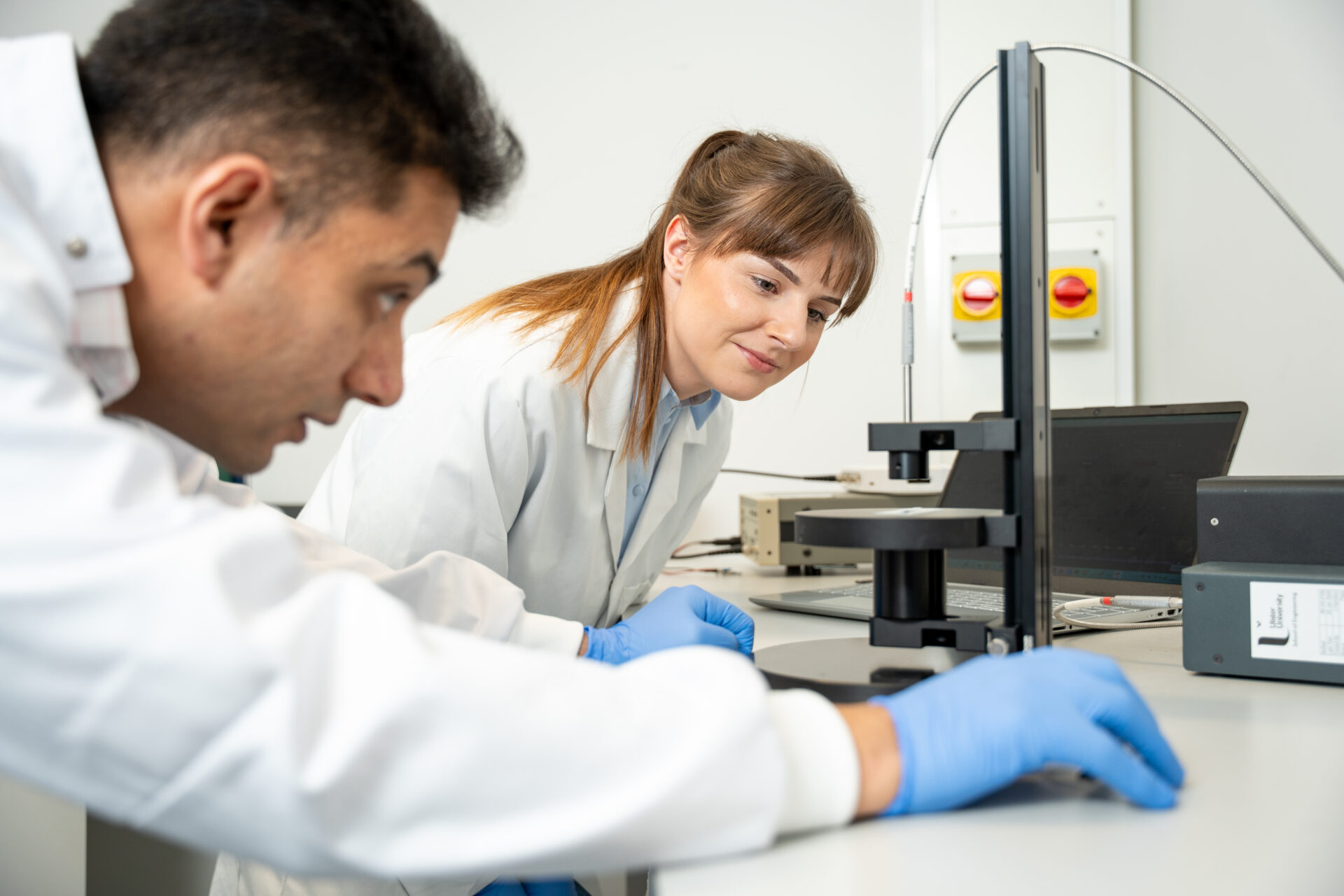
Within the Centre for Digital Healthcare Technology, an intersection of work is linking biosensors, nanotechnology, photonics, and digital healthcare to transform existing diagnostic technologies for Women’s Health. CDHT aims to create accessible diagnostic systems capable of detecting disease-associated biomarkers from non-invasive samples that are significantly easier and less burdensome to collect.
CDHT researchers are working towards developing a dedicated point-of-care platform. This diagnostic system is designed to identify clinically significant cervical abnormalities, specifically targeting cervical intraepithelial neoplasia grade 2 or above (CIN2+). By simultaneously capturing cellular protein biomarkers alongside disease-associated DNA methylation signatures, the platform gathers complementary biological signals. Analysing these two distinct indicators in tandem offers a substantially more reliable assessment of risk than relying on a single biological marker alone. Importantly, this innovation is planned not to replace existing infrastructure, but to directly complement established cervical-screening pathways.
CDHT are pleased to share some of the Key Developments of this Women’s Health based work so far:
There are a range of key technologies developed at Ulster University that support this platform; the diagnostic framework converges several advanced scientific fields to maximise sensitivity and practical utility. Paper-based and lateral-flow assays provide a physical foundation for low-cost and portable test strip architectures. CHDT expertise in nanomaterial-enhanced biosensing is leveraging functional nanomaterials to amplify subtle biological events. Controlled fluid movement to streamline complex, multi-step sample preparation steps is ensured with our long-standing experience by microfluidic sample handling. Our researchers use quantitative optical imaging to resolve faint, weak diagnostic signals that would otherwise remain undetectable to the human eye. By merging physical biosensing components with automated digital interpretation, this integrated approach with the Ulster University project, could ultimately enable compact testing devices ideally suited for decentralised medical clinics and resource-constrained environments globally.
Potential Impact on Global Healthcare Equity
While conventional cervical screening saves thousands of lives annually, global participation and access remain strikingly unequal. Many women face formidable practical, geographical, cultural, or personal hurdles when attempting to access traditional screening services.
A point of care test strip offers a far more acceptable entry point into screening or triage pathways, especially for women who are consistently under-screened or hesitant to undergo invasive clinical procedures. Furthermore, by identifying women at higher risk of CIN2+ earlier in the care continuum, healthcare providers can ensure prompt referral and appropriate follow-up. Simultaneously, this precision risk profiling helps prevent unnecessary anxiety and invasive clinical interventions for women who remain at lower risk. The ultimate objective of this work extends beyond creating a highly sensitive sensor; it strives to build a diagnostic technology capable of delivering a genuinely accessible and equitable healthcare pathway.
Challenges of Implementation
Challenges exist for researchers to translate new technologies into the hands that need it. In this particular CDHT project example, there are a range of challenging factors involved. Firstly, the biological variability, managing extremely low and variable biomarker concentrations in urine, alongside natural variation in individual sample compositions. Sample handling logistics in different geographic context can be difficult, whereby it is necessary to optimise strict sample-storage parameters and streamlined preparation requirements.
Clinical evidence can be a hurdle to obtain as conducting large, representative clinical studies to validate sensitivity and specificity before practice patterns can change, timely and expensive. Integration with Regulation and Health Systems is a necessary and complex to understand and obtain approvals. Navigating regulatory approval frameworks that vary from region to region, ensuring batch-to-batch manufacturing reproducibility, establishing cost-effectiveness, securing data governance, and integrating smoothly with established healthcare infrastructure is a regular and known challenge within Life and Health Science commercialisation patways.
Preventing digital inequality is key when developing technology-based solutions for healthcare. Ensuring digital health innovations actively reduce disparities rather than generating new digital divides. Addressing this requires robust Patient and Public Involvement (PPI), specifically partnering with women from communities that historically exhibit low screening uptake or face poor healthcare access.
A Wider Perspective on Women’s Health
A foundational lesson reinforced by the recent CDHT and Place Based Impact Accelerator Account Sandpit event is that complex healthcare challenges cannot be solved in isolation by a single academic discipline. Driving real progress requires continuous, multi-sector collaboration that bringing together biomedical engineers, clinicians, cancer researchers, data scientists, implementation specialists, and patients to co-design technology from the outset.
Our overarching guiding principle at CDHT is simple yet transformative: healthcare technologies must be designed with women, rather than simply for women. True success must not be measured solely by analytical laboratory metrics, but by the acceptability, practical accessibility, and real-world impact the technology brings to women’s healthcare pathways worldwide. To find out about CDHT please visit www.cdht.tech
Research by Nikhil Bhalla – Ulster University