Women’s healthcare has been historically fragmented and episodic. Care often happens in isolated visits focused on a single issue or life stage, rather than a continuous, coordinated journey. Too frequently, women have their symptoms treated separately by individual specialists, leaving them to navigate health systems alone and experience delayed diagnoses and incomplete support.
Shifting to a connected, life-course model can deliver more effective, personalised care – seeing each woman as a whole person, linking specialists and primary care, and supporting her health proactively at every stage of life.
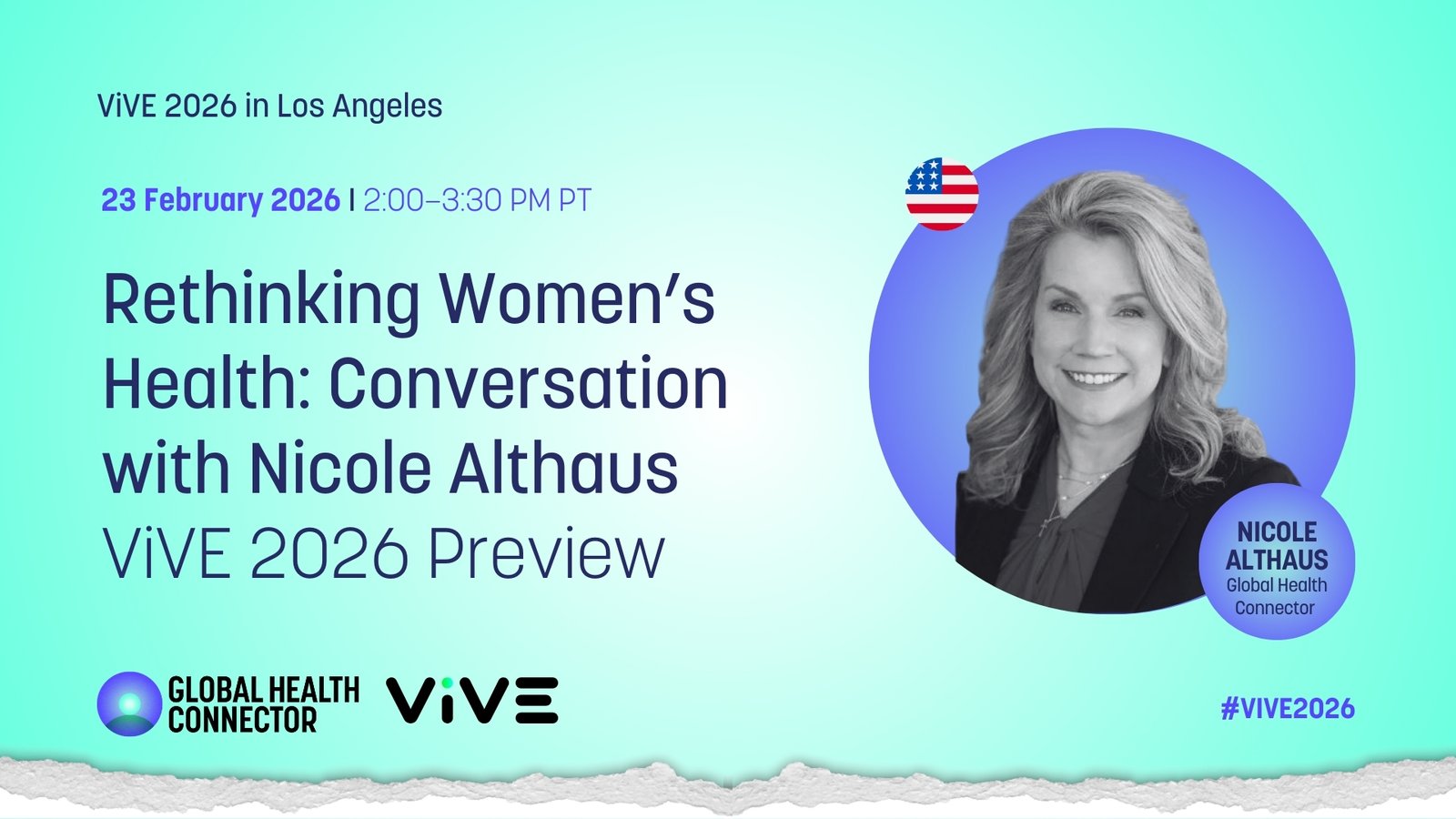
This is an important topic that will be discussed as part of our special Partner Programme at ViVE 2026 on 23 February in Los Angeles.
Our US Ambassador, Nicole Althaus, will be part of the session “Women’s Health: From Episodic Care to Lifespan Platforms”. In this blog post, Nicole shares key insights and background on the subject, which will be explored in more detail at the event.
Q1: Why has women’s healthcare historically been so fragmented, and what has been the cost of that fragmentation?
Women’s healthcare has been built around moments, not lives. Care has been organized by specialty and life event, rather than by how women actually experience health over time. As a result, women are often left to connect the dots themselves across pregnancy, chronic conditions, mental health, caregiving, and aging.
The cost shows up everywhere. Missed diagnoses, disjointed transitions, and unnecessary stress for women already carrying a heavy load. System-wide, fragmentation drives higher costs and poorer outcomes, especially for women navigating multiple roles or complex care needs. But the deeper cost is quieter: the erosion of trust, the normalization of being unheard, and the message that women’s health only matters in narrow windows of time.
Q2: How do we move from episodic care to continuity of care across a woman’s entire life course? What does a whole-person approach involve?
We move forward by designing care around continuity, not transactions. A whole-person approach recognizes that health is shaped by life context, not just clinical events. It means supporting women across stages, with care models that evolve as their needs change.
That requires longitudinal relationships, better coordination across specialties, and integration of physical, mental, and social care. It also means meeting women where they are, acknowledging the realities of work, caregiving, and access, and building systems that reduce friction instead of adding to it. Imagine a system where every woman has a care advocate who knows her story, anticipates transitions, and helps her stay well, not just treated. That is the future we should be building toward.
Q3: What are the biggest challenges preventing integrated women’s health care today?
Many of the barriers are structural. Payment models still reward episodes, data remains siloed, and accountability across time is unclear. Even when the intent to integrate exists, the infrastructure often does not support it.
There is also a historical gap. Women’s health beyond reproductive years has been underdesigned, which limits how care pathways are built today. But these challenges also reveal opportunity. The systems we are questioning were never designed for women’s full lives, which means we now have the chance to redesign them intentionally. True integration requires new partnerships across health systems, community organizations, and innovators, and alignment across groups that have not traditionally worked together.
Q5: How can a connected women’s health ecosystem reduce inequalities in access and outcomes?
Connection changes access. When care is easier to navigate and better coordinated, women are less likely to fall through the cracks during key transitions such as postpartum, menopause, or periods of caregiving.
A connected ecosystem also allows needs to be identified earlier and support to be customized more effectively. By linking clinical care with navigation, community resources, and human support, we can reach women who have historically been underserved and shift care from reactive to preventive. This is not just about closing gaps. It is about creating pathways that did not exist before, so every woman, regardless of geography or income, can access care that sees her whole. That is where equity and better outcomes begin to align.