Organization Name: Center for e-Health Innovation (CIeS) / MOHIM Lab
Introductory summary: Morocco has embarked on a profound transformation of its healthcare system by addressing the major challenge of medical data fragmentation. This article presents the MOHIM project (Morocco Health Interoperability and Maturity Lab), the first national digital health infrastructure initiative of its kind in Africa. Breaking with traditional approaches, MOHIM proposes a model of “ecosystem-driven interoperability” and is built on a founding strategic partnership with IHE Catalyst to ensure the adoption of international standards and continuous validation through practice.


Interoperability is now emerging as a critical national infrastructure, on the same level as digital identity, determining the continuity of care and the steering of health policies. Aware that isolated pilot projects are no longer sufficient to ensure long-term impact, the Kingdom of Morocco has launched the MOHIM programme (Morocco Health Interoperability and Maturity Lab).
Led by the Center for e-Health Innovation (CIeS) of Mohammed V University in collaboration with the Ministry of Health and Social Protection, the MOHIM Lab aims to support digital health ecosystem stakeholders in implementing interoperable, secure and patient-centred information systems, and to provide the country with a structured, sovereign national interoperability framework (CI-SIS Morocco) aligned with global standards.
The Central Role of IHE Catalyst: The “Guardians of the Standard”
Launched following GITEX Africa 2025, the MOHIM project is built upon a major strategic collaboration with HIMSS and IHE Catalyst. Within this framework, IHE Catalyst plays a fundamental role that goes beyond simple advisory support: they act as the “Guardians of the Standard.”
Historically, many eHealth programs have failed due to the top-down imposition of theoretical specifications. The MOHIM model draws inspiration from the methodology of IHE Catalyst to reverse this paradigm: interoperability cannot simply be mandated, it must be built through practice and testing.
The contribution of IHE Catalyst is structured around three major pillars:
A Three-Tier Governance Model for National Consensus
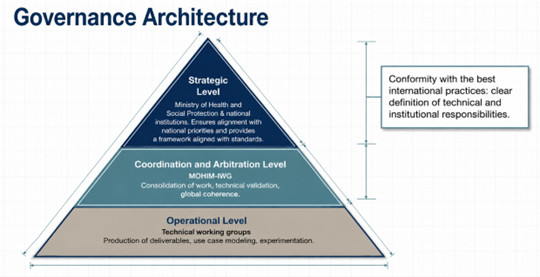
To ensure that technical standards are effectively implementable, MOHIM has established a three-tier governance structure inspired by European best practices.
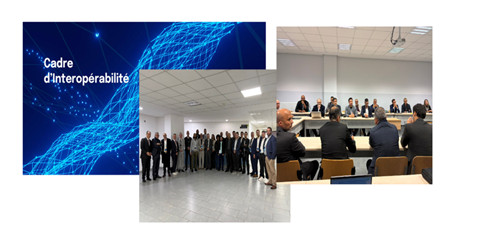
The State ensures sovereign validation (Level 1); the central MOHIM-IWG (Interoperability Working Group) oversees technical consensus (Level 2); and the domain-specific working groups collaboratively develop specifications in the field (Level 3).
Thanks to this rigorous framework and the support of partners such as IHE Catalyst, Morocco is not merely modernizing its own healthcare system. The MOHIM Lab is intended to become a center of excellence for testing and certification, paving the way for an interoperable and inclusive digital health ecosystem across Africa, while ultimately facilitating cross-border health data exchange.
The Brussels Milestone: Building European Synergies
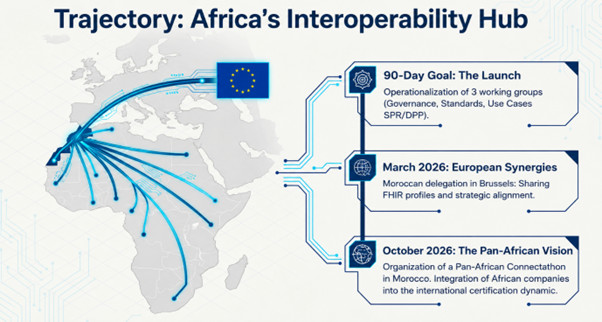
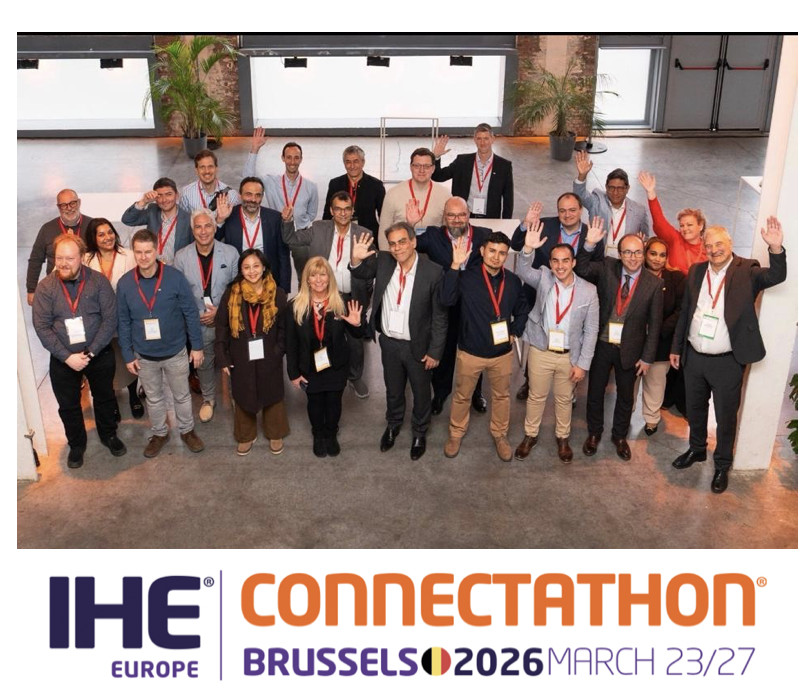
This commitment to aligning with global best practices was illustrated during the IHE European Connectathon held in Brussels from 23 to 27 March 2026. On 24 March, during a “Delegation workshop” dedicated to digital health stories around the world (“Digital Health Stories around the Globe”), Prof. Anass Doukkali (President of CIeS) and Izhar Mahjoub (MOHIM Coordinator) shared the Moroccan experience. This strategic presence in Brussels made it possible to identify new synergies, pool expertise and accelerate the sharing of FHIR implementation profiles between Morocco and Europe.
Toward a Pan-African Future
The MOHIM story will not stop at the borders of the Kingdom. Building on this synergy with Europe and its partnership with IHE Catalyst, Morocco is positioning itself as the future interoperability hub of the African continent. The next milestone is now set for October 2026, with the ambition of organizing a major Pan-African Connectathon in Morocco to integrate African vendors into this international certification dynamic. A decisive step toward a future where health data can travel as freely and securely as the citizens they are meant to protect.